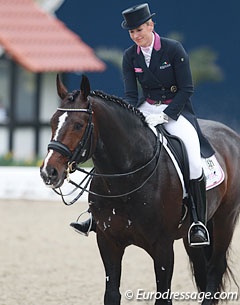
The walk is the proof of relaxation and correct training. The walk is often the most overlooked and yet the most difficult pace in the sport of dressage. As our sport has evolved it seems that the trot and canter have become more impressive, more powerful, more brilliant, while the walk has become more tense, less regular, with an incorrect weight proportion, and an unstable contact.
Why are the marks for trot, canter, piaffe and passage reaching 9’s and 10’s at Grand Prix level, while the marks for the walk are flattening out or even dropping as a whole?
Colonel Christian Carde of the Cadre Noir says the importance of maintaining a good walk lies in the upper line of the horse, and that in modern day sport the contact is becoming too strong. Thus the walk is showing the effect of the weight distribution at the front of the horse.
“To get a good walk the horse must be supple in his top line. However this is only possible if the contact with the rider's hand is as it is written in the FEI regulation : "the horse accepts the bit, with a light and soft contact and a supple poll," the Colonel remarked.
It seems that as horses reach the top levels of training, they begin to rely on the hand to lift the horse up and try to establish lightness, when lightness is a product of engagement and self-carriage.
“The tendency nowadays is to get a too strong contact and for the rider to clench the noseband too much. There is then a direct effect on the quality of the walk which becomes difficult,” Carde added.
Bemelmans and Klimke Have a Say on the Walk
Belgian-German trainer Jan Bemelmans reminds us that if we judge a horse then all three paces are of the same importance. Particular attention must be paid on granting the walk it’s equal importance.
“In Grand Prix the canter and trot have more exercises, so there are more chances for the quality of these paces to flow into the judging," said Jan. "This means that it is very important that there is good and clear judging of the walk.”
Bemelmans feels that the extended walk is not too difficult to judge, but that the collected walk needs more attendance, as it is not so spectacular as the piaffe but in terms of the degree of difficulty in can be the same, or some times even greater.
“There is rarely a ten given for a good collected walk, while for piaffe and extended trot the judges are more generous," he stated.
With correct training Jan knows it is not difficult to keep a good walk from a young horse up to Grand Prix level, but riders must be careful to get the walk right.
“Walk is a clear 4-beat gait, so the most crucial aspect for riders and trainers is that as soon as you begin to shorten the walk, you make absolutely sure the 4-beat is not destroyed.”
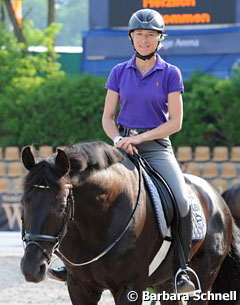 One of the best pieces of advice to give riders who are unsure of how to ride the walk, according to Jan, is that if you feel uncomfortable or don’t have confidence in the walk, don't collect it on a straight line and rather go into shoulder in at the walk.
“Lateral movements like shoulder in and half passes help to bring your horse back in balance and thus maintain the quality of the walk by not letting him fall onto the shoulder," said Bemelmans.
German Olympian Ingrid Kilmke advises that the walk is the gait that shows if the horse is supple and content. She says that it is not difficult to keep a good walk into the top levels of dressage if the horse is relaxed.
“People can often ruin the walk in training if they start to collect the walk too early with the reins too short and too much tension," said Ingrid.
Ingrid advises that the best way to overcome this issue, is to help teach the horse to stretch and relax in the other gaits.
“If the horse is stretching in trot and canter then the walk is relaxed too. When you start your ride walk for ten minutes in a free walk with long reins,and when you take the reins start in trot and not in walk on the bit," said Ingrid.
What Non-Competitive Classical Trainer Belasik Weighs In
Well known author, clinician and trainer of classical dressage, Paul Belasik believes that in terms of competitive dressage tests the walk can be used to allow the horse to rest and so must show relaxation to carry out its purpose.
“If the horse doesn't calm down when asked to walk, or if the walk gets lateral, the rider may be using too much hand, and he slows the front feet down while the hind legs continue at a regular speed without impulsion. The walk can then be seen as a window into the type of riding and training that is going on in the rest of the gaits.”
When asked why the walk seems to become short and tense as the training progresses, Paul notes that in general this is because, for lots of reasons, competition hinges on comparison and imitation, often without the proper analysis of technique.
“People push. They see a trot gets a 7 because it is this big and they assume a bigger trot will get an even bigger score. It is part of our culture, if I take one pain pill think how much better I will feel if I double the dose; more, more always more! As a result of this “push too hard” mentality, riders are not educated to understand the subtleties of dressage," Belasik firmly stated.
 Paul added that without the “breath of fresh air” that comes with a relaxed walk, the riding just aggravates the horse, as it is always dissonant and aggressive.
“If your objective is some new kind of punk dressage I suppose that is one thing, but if you are just doing it badly that's quite another," he said.
In order to really improve the quality of the walk shown in competition, the answer according to Paul lies in the judges sticking to the rules and judge accordingly: penalise or reward without regards to who it is.
“The other thing is to make sure the choreography of the test isn't a trap placing the walk too close to movements that require more power, it's like a good jumping course, a few feet off in the distances can be the difference between a challenge and a trap," he added.
Overall Paul notes that the walk will be destroyed if the rider is always pushing, chasing the movement as if it were a race, getting addicted to frantic on the edge riding. The only true solution is to walk out, walk on long reins, chill!
“Chasing and pushing is not supposed to be dressage! Dressage is about beauty and harmony, certainly athletic, but not just athletic, athletic with relaxation, a form that is so much harder to achieve.”
by Sarah Warne - Photos © Astrid Appels - Barbara Schnell - private