-- Text © Silke Rottermann for Eurodressage - Photos © private archive Lehmann
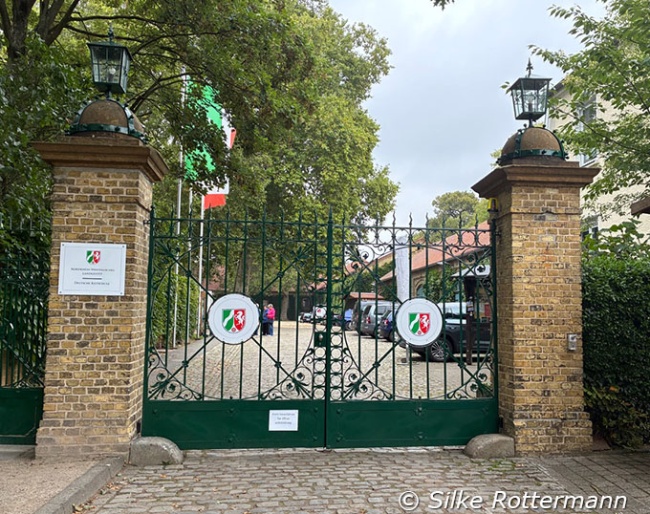
Tucked away a bit, yet very close to the historic city center of Germany’s equestrian capital Warendorf, a charming dark-green iron gate flanked by two imposing brick towers can be spotted by the attentive visitor. Behind it lies one of Europe’s largest and most impressive stud farms, which celebrated its 200th anniversary at the end of August 2026: the North Rhine-Westphalian State Stud.
Founded in 1826 as the Prussian-Rhenish-Westphalian State Stud, today it is regarded as an indispensable institution, not only by the residents of Warendorf, but also by many horse enthusiasts around the world. The city of Warendorf and the State Stud mark this anniversary with a variety of events, which culminated in a festive weekend on 28 - 29 August 2026. At times like these, people tend to take for granted what has been painstakingly achieved, preserved, and further developed throughout history, including through the two devastating World Wars.
Reason enough to take this 2026 jubilee as an opportunity to look back on the life and work of Warendorf’s principal stud stud director of the 20th century to whom we owe more than just the fact that Westphalian breeding has become one of the world’s leading breeding programs. During an extremely difficult period, when Germany, a horse nation, faced the major challenge of finding a new role for horses, the faithful companion of mankind, a young visionary succeeded in preparing the State Stud and its breeding program for the future. He did so through wise initiatives and played a significant role in ensuring that the North Rhine-Westphalian State Stud is able to celebrate two centuries of existence.
We are talking about Dr. Gerd Lehmann, a true groundbreaker.
"The Horse Must Stay"
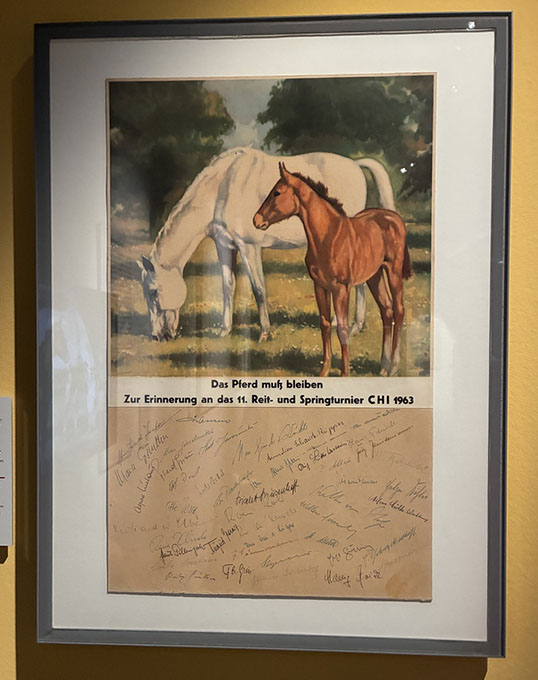
'The Horse Must Stay' in the
Westphalian Horse Museum Münster
In the state of North Rhine-Westphalia, founded in August 1946, the horse population hit a low point in 1962 and the decline in breeding numbers and horse population spread throughout the entire West German Republic. There seemed to be only one way to reverse this negative trend and that was to give the horse a continued place in society as a partner in sports and leisure. At the time German society was just beginning to get back on its feet economically after the devastating years of war and find its place in a Europe shaped by the Cold War.
Just how worrying the situation was and how seriously the horse world in Germany took it was impressively demonstrated on 15 March 1963. For the event “Das Pferd muss bleiben” (“The Horse Must Stay”), held on the occasion of the 11th International Indoor Horse Show in Dortmund, state and private studs, riding clubs and top riders pulled together. During an evening event lasting several hours, countless displays reminded the audience of how humans have depended on horses throughout history and this sensitive, noble animal should continue to be a part of our lives.
The Initial Post-War Situation
At that time the German breeding associations were well aware of the situation, which could certainly be described as precarious. The order of the day was to restructure breeding.
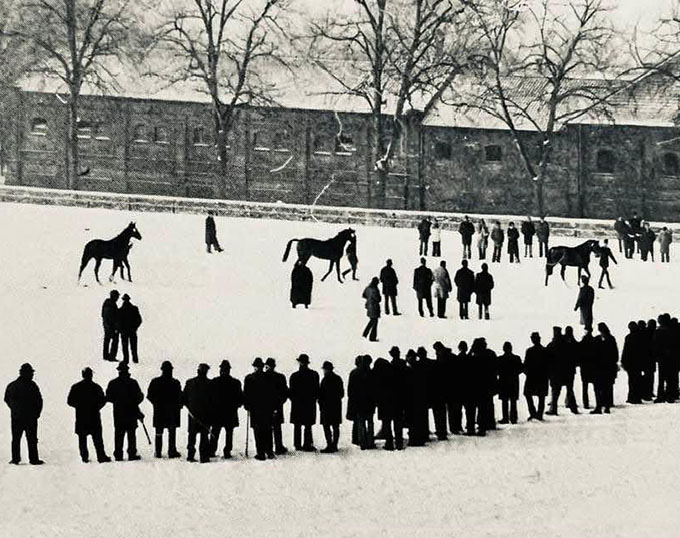
The situation in North Rhine-Westphalia with its breeding was no different, that is, if we set aside the private Vornholz stud farm in Ostenfelde, not far from Warendorf. There, Baron von Nagel-Doornick had been deliberately breeding sport horses since 1937; he wasn’t only very successful for about the four decades until his death, but he was far ahead of his time from the beginning of his breeding operation at Vornholz Castle.
Since 1939, it had been Konrad Bresges who oversaw the operations of the state stud in Warendorf as state stud director. The challenges he had to overcome during the Third Reich and especially in the immediate aftermath were immense and are beyond our comprehension today, but he succeeded in maintaining the state stud in Warendorf as such. However, Bresges naturally belonged to the generation in which horses were bred primarily for service in the cavalry and on the farms.
Accordingly, as Michael Stoffregen-Büller describes in his remarkable book „Die Heimat der Hengste“ („The Home of the Stallions“), Bresges approached the refinement of warmblood breeding at the stud in the 1950s with great caution. “It would be fundamentally wrong to prescribe the thoroughbred stallion as a universal solution,” he is quoted in the aforementioned book. It was certainly understandable for a man of his generation to find it difficult to wholeheartedly tackle the restructuring of breeding in line with new market demands.
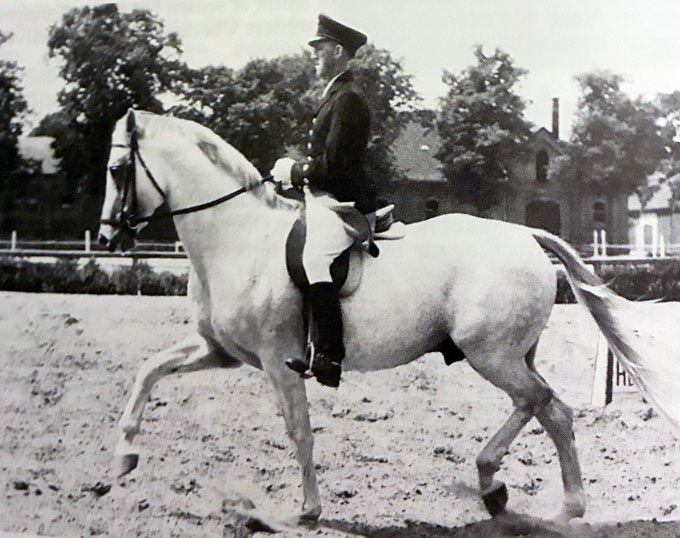
sire Radetzky (Ramzes AA x Oxyd)
At the beginning 1960s Bresges’ era at the state stud was slowly drawing to a close and the responsible ministry of agriculture in Northrhine-Westphalia was on the lookout for a suitable successor.
A Young East Prussian For Westphalia
Shortly before Easter 1964 a certain Dr. Gerd Lehmann received a letter of invitation from Gustav Niermann, then Minister of Agriculture of North Rhine-Westphalia, to attend an interview for the position of state stud director in Warendorf.
Lehmann, born in 1933 and an agricultural engineer with a very solid background despite his young age, was one of three candidates for this position to succeed Bresges. The position at the time carried even more responsibility than it already did. The 31-year-old Lehmann was working for the Trakehner Association in Hamburg as an assistant to the legendary Dr. Fritz Schilke who had rendered outstanding service to the reconstruction of Trakehner breeding in the West. Lehmann was considered his designated successor.
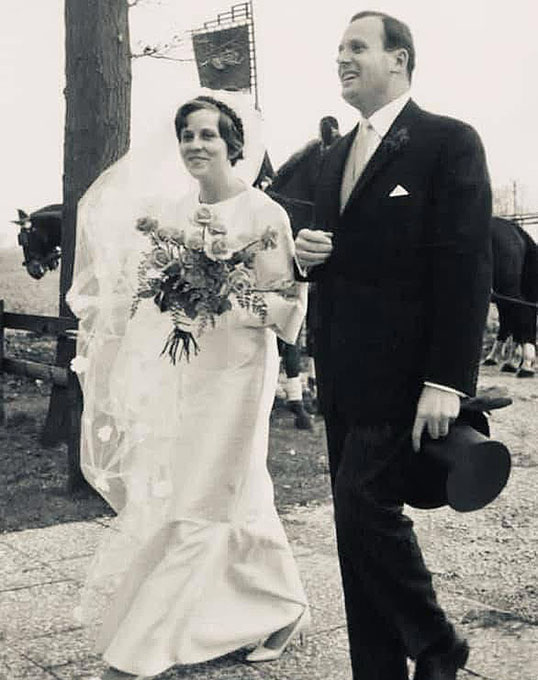
What had been a wonderful childhood came, with the collapse of the Eastern Front in the summer of 1944, to a dramatic end when Russians were on the land of the Lehmann family and they had to evacuate in no time. Like countless East Prussians who suffered the same immeasurable fate, the Lehmanns were forced to flee in late October 1944 along with their mares. They lost their home forever. In January 1945, with the Red Army’s occupation of Osterode in East Prussia, they were taken as Russian prisoners of war and lost their beloved mares.
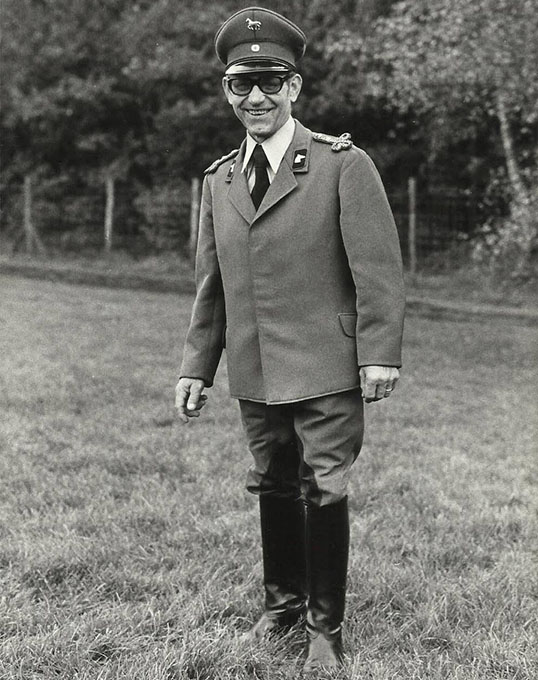
And who knows, perhaps Dr. Gerd Lehmann also recalled his doctoral advisor, Professor Krüger, when making his decision. Krüger had once prophesied to him in the late 1950s: “Horse breeding will perish, and you along with it!” Ensuring that exactly this did not happen was a matter close to his heart.
Lehmann’s decision to take on the extremely challenging task of modernizing the Westphalian State Stud and its breeding program and thereby securing their future, as one could certainly say at the time, marked the beginning of a golden era from which both the breeding program and the stud still benefit today. However, this era certainly would not have been possible in the way it then happened without the newly appointed managing director of the Westphalian Horse Stud Book, Dr. Ferdinand Dohmen.
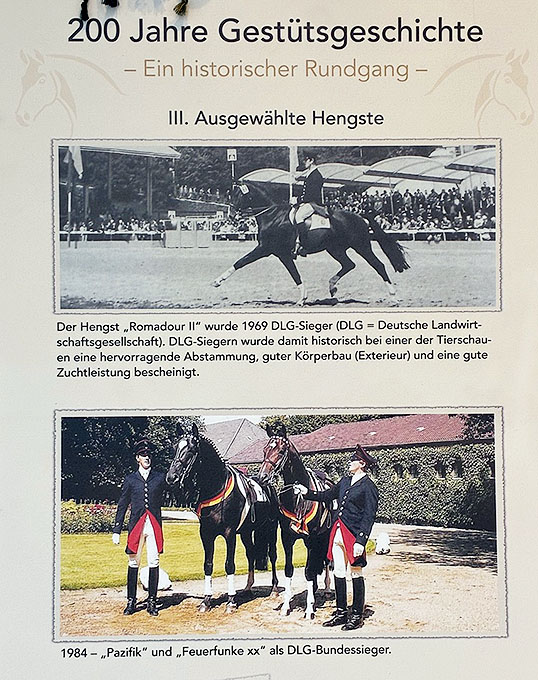
windows to mark the 200-year-anniversary
of its state stud
In the decades that followed, Dr. Dohmen would form a successful duo with Dr. Lehmann, the likes of which the history of state stud farms in Germany has scarcely seen. The two complemented each other so exceptionally well that the breeding reform process in the breeding regions of North Rhine-Westphalia received a carefully orchestrated boost.
On 1 April 1965, Dr. Gerd Lehmann was officially appointed state stud director of the North Rhine-Westphalian State Stud after serving as a stud assistant alongside former state stud director Konrad Bresges as of October 1964
Like his predecessor, Lehmann would hold this position of responsibility for several decades and took an absolutely decisive influence on the state’s breeding program through his decisions and innovations.
More on that in Part II of this article series.
-- Text © Silke Rottermann for Eurodressage - Photos © private archive Lehmann - Silke Rottermann
Reference List
- Conversations with Dr. Gerd Lehmann on 11 August 2026 and 1 September 2026.
- Hermann Kothe, Vollblut in den Landeszuchten - Ist Härte nicht mehr gefragt?, in: Sankt Georg 10/82, Seiten 50 - 57.
- Knoll, Lore, Preuße alter Schule, in: Sankt Georg, 12/83, Seiten 66-69.
- Hans-Joachim Köhler, Vom Wirtschaftspferd zum Leistungssportler, in: Sankt Georg 12/84, Seiten 36 - 40.
- Franz-Josef Neuhaus, Zuchtschätze, Bedeutende Stutenfamilien in Westfalen, Münster ohne Jahr, Seiten 186 - 205.
- Jasper Nissen, Geht der Zucht der Saft aus?, in: Sankt Georg 4/2000, Seiten 13-17.
- Reiter und Pferde in Westfalen (Hg.), Pferdezucht im Wandel - Festschrift für Gerd Lehmann, 25 Jahre Landstallmeister in Warendorf, Münster-Hiltrup 1991.
- Rolf Schettler, Hengstauswahl - Zuchtfortschritt mit bewährten Alten oder modernen Jungen?, in: Sankt Georg 11/85, Seiten 52 - 53.
- M. Stoffregen-Böller / F.-J. Neuhaus / O.Marré / H. Heuoel, Westfalen-Die Jahrhundertpferde, Münster 2004.
- Michael Stoffregen-Büller, Die Heimat der Hengste: 175 Jahre Warendorfer Landgestüt, Münster-Hiltrup 2001.