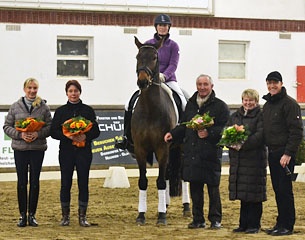
Four hundred people gathered in the indoor arena of the Regional Performance Centre in Neuwied, Germany, for a dressage clinic with Riding Master, Olympic Team Champion and international top trainer Klaus Balkenhol and German Grand Prix trainer Wolfgang Kutting. The announced topic for the clinic, “The meaning of half halts and contact," appealed to the audience which was soaking up the information and craved for more.
Organized by the Xenophon Society for the preservation of classical dressage, this clinic happened in cooperation with the “Personal Members” (PMs) of the German Equestrian Federation (FN).
The Grecian riding master and philosopher Xenophon said in 400 BC “with more collection there is more balance. The horse takes more weight on his hind legs, carries itself and gains the charisma of a fascinating personality.” In response to this quote Wolfgang Kutting stated that "actually this says it all. That is what dressage is about: To train the horse in a way, that it is able to show its entire beauty. By choice, without force. Then it’s easy, then it’s beautiful. That is the moment when riding becomes art. But the way to get there is long and requires the rider’s passion and patience."
This road, however, is such a rewarding undertaking. Once one has experienced the feeling to literarily gel with the horse, it will never be forgotten. When you only have to think of what you would like to do next and the horse reacts even before your aids. To feel and to connect with the horse is everything in riding. However, the rider also has to understand how his aids have to interact, in order to support the horse without disturbing it. This interaction was Wolfgang Kutting’s topic in Neuwied.
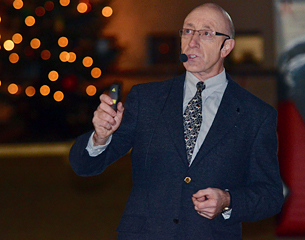 Kutting explained from a biomechanical point of view how the rider should use his body once he mounts a horse. He used an impressive picture: “When musicians of an orchestra tune their instruments there is no harmony, no melody, but when they listen to each other and follow the conductor they create art. This is the way aids should work: like an orchestra, in order to help the horse becoming a living peace of art.”
One thing has to be kept in mind. Always, no matter if you like to extend or collect, driving aids come first. The reins can pick up the impulse from behind, but they have to let it out again immediately. This has to be practiced until (and it can take years) the horse carries itself with the slightest contact possible. Yet there has to be a contact. Then it feels as if you have the horse “in front of you”. The freedom of the shoulder increases and thus the movements become more cadenced and elevated. Every horse can move like this, it does not have to be a “German Young Horse Champion”.
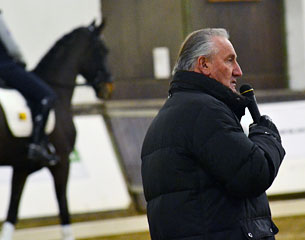
After Wolfgang Kutting’s theoretical explanations about when which aid is required, it was Klaus Balkenhol’s task to show this in practice. Accompanied by three riders and horses of different age and levels of training, Balkenhol flawlessly exemplified Kutting's words. Even though you can read a lot about it, you finally have to experience how a submissive horse feels like. A horse that reacts to your slightest aids, or rather just to your thoughts. Also to the wrong ones. Because this is the only way to learn when you own orchestra of aids interacts properly: keep in mind the phrase “Young rider, old horse – old rider, young horse”.
 What also helps is watching. Corinna Schumacher was one of the three riders who demonstrated good dressage work with a 4, a 7 and an 8-year old horse. Schumacher is a Grand Prix winner herself. Her 4-year old horse was really impressed by the crowd in the stands. Consequently the gelding was quite tense, tight and strong in the beginning. Together with Klaus Balkenhol’s support the situation changed entirely within 30 minutes. After a lot of transitions between trot an canter the horse gained more and more suppleness, got steady and yet easy in the contact. Finally the youngster’s movements grew absolutely even, relaxed and ground covering. He nicely stretched his neck towards the bit and looked really satisfied. It was a good moment for a 4-year-old to finish the lesson. The older horses demonstrated how lateral work (shoulder-in, half-passes) in combination with soft extensions can help to improve the movements, insofar as the rider's hands are soft enough to allow the horse to grow “bigger”.
Anabel Balkenhol, Klaus Balkenhol’s daughter, then showed on an 8-year old horse on its way to Grand Prix level what it looks like when everything works: flying changes in different tempi, pirouettes, half-passes, half steps up to a beginning piaffe with the softest contact and invisible aids in great self-carriage.
Dressage can be so beautiful when the slightest aids are sufficient and the horse really looks like a happy athlete, proud to show itself. “If there were more riders and trainers like these, fewer horses would have to suffer. Even my husband who is no horseman at all now has an idea about half halts," a spectator commented after the clinic.
Text by Dominique Wehrmann
Related Links
An Evening Dedicated to Classical Dressage and Harry Boldt
Inspiring Xenophon Seminar in Münster
Xenophon Society Appeals to the German Equestrian Federation on Blood Rule
Xenophon Society Makes Statement on Rath's Trainer Choice