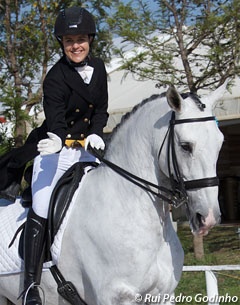
We often refer to the “art of dressage” not simply because it is a thing of beauty, but because it is not a science that one can study. To be a great rider you must have feeling and compassion, tact and discipline, respect for the horse and a peace within your own mind.
Often we get caught up in exercises, in the right and the wrong of how we perform certain movements, losing the real point of why we do what we do. To produce a test is not the hard part, to produce a test with a horse that shows harmony and expression is a different thing altogether.
What makes our sport unique is the relationship between horse and rider. In order to produce harmony between the two, a rider must not only feel, but also know his horse. In order to feel, you must know that the basics are the single most important thing in our sport. If you get that right, the rest comes easily.
Nuno Oliveira said that “A short description of equestrian art is:
1. Do a 6 metre volte at any gait with the rider feeling equal sensations on both sides.
2. With a correct position of the horse
3. With a correct cadence
4. With respect to the geometry of the exercise (i.e. round circle)
Nuno felt that if you could perfect the above, then you had a clear and solid foundation. Unfortunately in dressage it’s not enough just to practice things over and over, we must feel and learn and take information as we practice. “Dressage is not an exact science, we must “feel”," Oliveira stated.
Quite often we go out and we do a circle, but we forget to feel what is happening every step of the circle. We watch other riders and we can see the horse's shoulder falling out, or his quarters coming in. We can see the faults, and yet quite often we too ride a circle without feeling and thinking what is happening.
It’s amazing to see what happens when you ride out everyday and think about the straightness, the suppleness, the bend, where the weight is going. Things we all know but often get mixed up in a haze of other thoughts, like what is my left hand doing, or what is that bush over there? We focus a lot of our attention to the outside influences, or our own issues with position, instead of wondering about what the horse is telling us. If we focus more on the horse, on his energy and feeling, and weight distribution, it’s amazing how many other elements fall into place.
An important point to decide is: What is the dose of nervous energy required of the horse? And what is the level of relaxation we must let him have?
This again is a concept that cannot be taught, but must be learned over time. The best trainers I’ve had in my life have often said little about what to actually do, but given me exercises and helped me to understand when I was executing them correctly. In this way we learn to “put into our computer” what it feels like when the horse is going correctly. We can be told what aid to give, but it is by applying this aid, and understanding how much sharpness or subtlety we must use to get our desired response.
Furthermore, Nuno said: "Equestrian tact is not only the subtlety of the aids but also the feeling for the choice of the aids that have to be applied, and it is the velvet softness in the coordination."
When we can learn to feel what is happening underneath us, we can adjust ourselves and our aids according to how our horse feels on any given day, as this is another complexity of our sport. Our horse is never the same two days in a row. It is us who must adapt to him. If a rider rides the horse the same today as he did yesterday, but today the horse is with more power, the rider will simply hold onto the reins and try to bring the horse back into balance, without the ability to adjust his leg and seat aids accordingly.
Nuno Oliveira used to say that “training a horse is above all feeling and trying, according to what you feel, to help the horse and not to force him.”
If you find yourself having to force your horse to do things, then perhaps he is not yet ready? Perhaps he is telling you that he needs time to strengthen the right muscles in order to carry out the exercise with ease.
It is great to have a goal and to stick to it, but so many times we see riders pulling and pushing their horses into a way of going that is not correct. The end result comes from a place of learned helplessness rather than lightness and feeling. It is not meant to be easy, it is dressage!
by Sarah Warne - Photo © Rui Pedro Godinho