-- Text and Photos © Lily Forado
Wellington is a destination every equestrian enthusiast should experience at least once in a lifetime.. During the three-month winter season, Wellington becomes a true equestrian non-stop place, where Olympic riders, trainers, and professionals cross paths daily.
For the fourth time Global Dressage Festival was the venue for famous European dressage trainers to host a Masterclass in its international stadium. The series started with Carl Hester in 2018, followed by Isabell Werth in 2019, and Jessica von Bredow-Werndl in 2022. This year the audience was lucky not to get just one, but three Olympians in one arena through the sponsorship and generous hosting of Carol Cohen of 3 Graces Dressage.
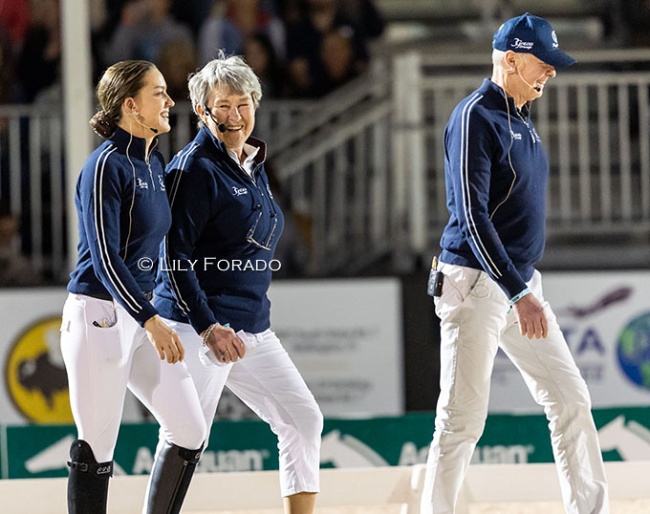
On Wednesday 21 January 2026 a sold-out stadium of 2,000 devoted dressage followers gathered for the "Dressage Infusion Masterclass". Education and entertainment flowed seamlessly in one arena, guided by three Olympic references in the sport: Kyra Kyrklund, Cathrine Laudrup-Dufour, and Jan Brink.
From young horses to Grand Prix, from youth riders to high-performance combinations, absolute concentration was required to absorb all the technical depth that came with their detailed explanations of the secrets and fine-tuned skills in dressage.
Kyra Kyrklund set the rhythm of the evening with her sharp eye for detail, while Cathrine Dufour and Jan Brink remained constantly engaged, adding nuance, experience, and continuous feedback. What emerged was not a sequence of demonstrations, but a lively conversation about training, feeling, and awareness of the aids.
Young Horses: Establish an Honest Connection
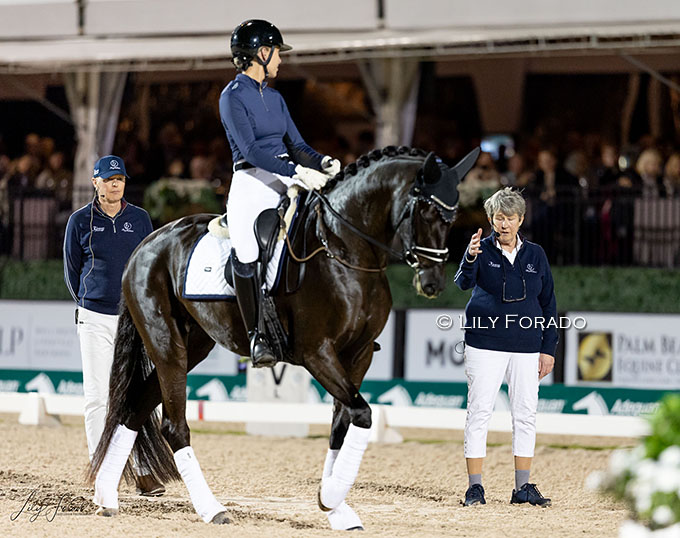
In the canter work, she highlighted the importance of the outside leg in creating true forward movement and quality of jump, reinforcing that clarity must always come before power. Working with a young horse, Kyra addressed collection with her characteristic pragmatism: “For me, collection starts when the rider gets on the horse.”
She also stressed the importance of automatisation in training; those unconscious patterns developed by both horse and rider through repetition. “To change an automatic thing, you need to repeat, repeat. What I do is really try to find short-cuts.”
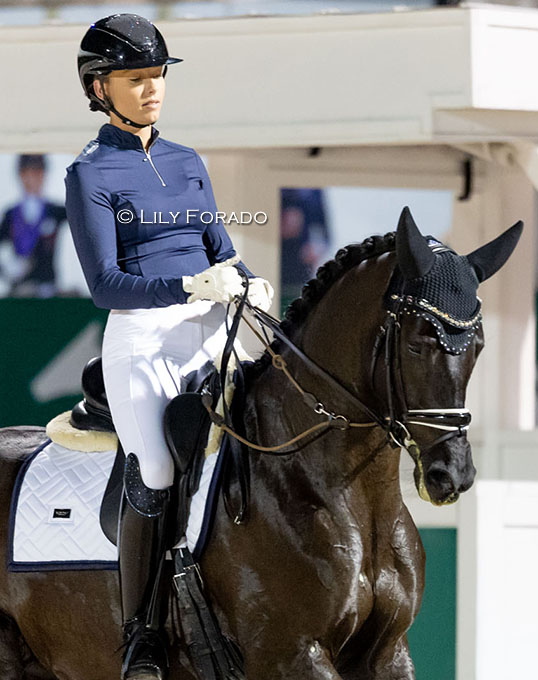
Exercises such as the turn on the forehand were presented as timeless tools, valuable from young horses all the way to Grand Prix. “We want to teach the horse to yield from the leg and step across the front leg; one or two steps, then relax.” At first, the mare struggled with the exercise, but through repetition and correct leg use, understanding followed.
When it came to rewarding the horse, Kyra underlined that the true reward is not the pat itself, but the release: “Patting with the hand; it’s not the pat, it’s the release of the rein that makes the difference.”
Cathrine Dufour: Seat, Weight, and Feeling
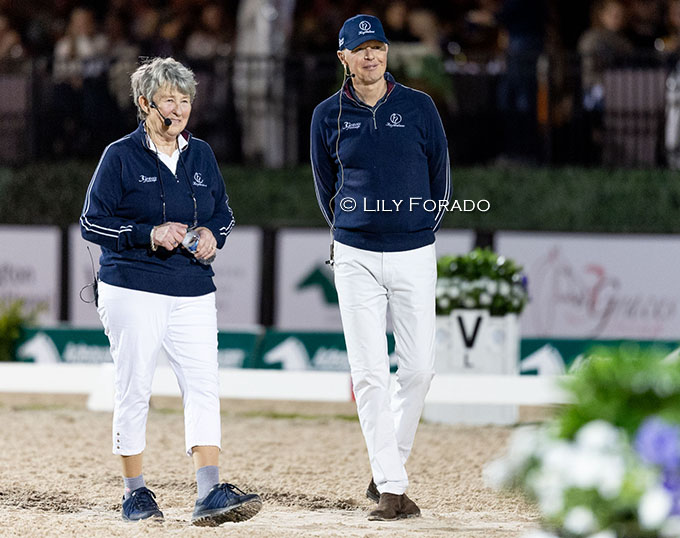
When Cathrine began riding the chestnut, the conversation moved decisively toward feeling and sensation. Together with Kyra and Jan, she explored weight as an aid, explaining how subtle changes in balance can make a horse quicker or slower without creating tension. Her riding demonstrated how rhythm and responsiveness can be shaped through body awareness rather than force.
Cathrine described exercises designed to develop sensitivity, including altering the rider’s rising trot rhythm—two up, one down. Kyra compared the process to dancing, where the rider leads and the horse responds. “The less you need to influence the horse, the better they will go.”
Laughter filled the arena when Cathrine delivered one of her famously metaphoric explanations of the seat. She spoke about mental pictures riders should use, to have the right position in the saddle with the shoulders back by visualizing closing her “bra clip" to help straighten her back, to the weight and positioning of the seat, by sitting deeply. Dufour admitted that Kyra told her off to sit more on her “anus ring.”
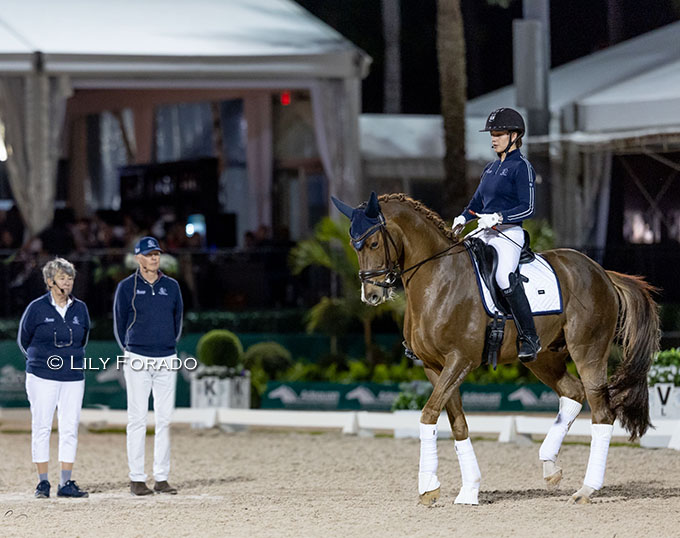
As the session progressed, tempi changes became a central theme. Kyra emphasized that changes are deeply “personal” to the rider and the horse, and that many problems arise not from the change itself, but from a lack of clarity in preparation.
Jan Brink added an important reminder about the value of pauses, echoed by Cathrine: “It’s not going to get better by doing more. You need repetition, but also breaks in between.” Jan insisted particularly on the importance of walk breaks.
Cathrine also highlighted the relationship between rider and coach. She explained that during her training sessions she talks constantly, offering feedback and exchanging impressions. “That little conversation is feedback. It’s partnership. I give clues about what I feel—it’s collaboration.”
Youth Riders: Weight and Awareness
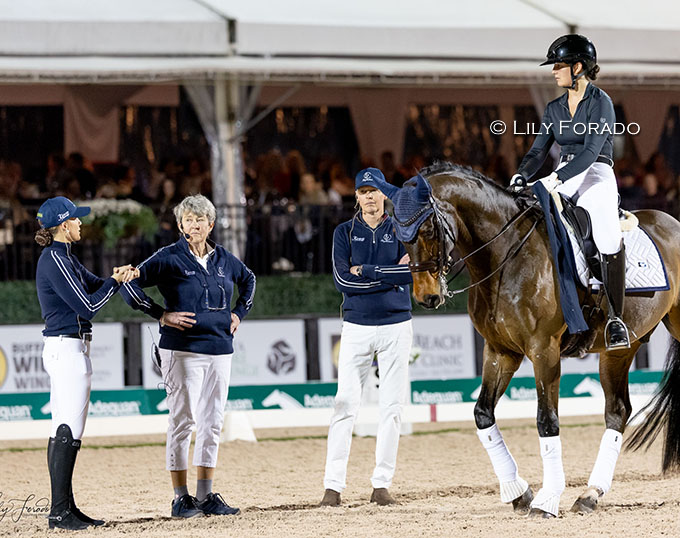
To facilitate this awareness, Kyra introduced another of her tools: a bandage placed over the horse’s neck. Cathrine described it as a “game changer,” explaining that it gives the rider a clear feeling of resistance when pulling, and a reaction when lifting the horse’s back; directly influencing the chest.
As the session progressed, Virginia found a clearer rhythm in the trot. Kyra suggested counting the steps between letters and adding two more steps to improve quality without increasing speed.
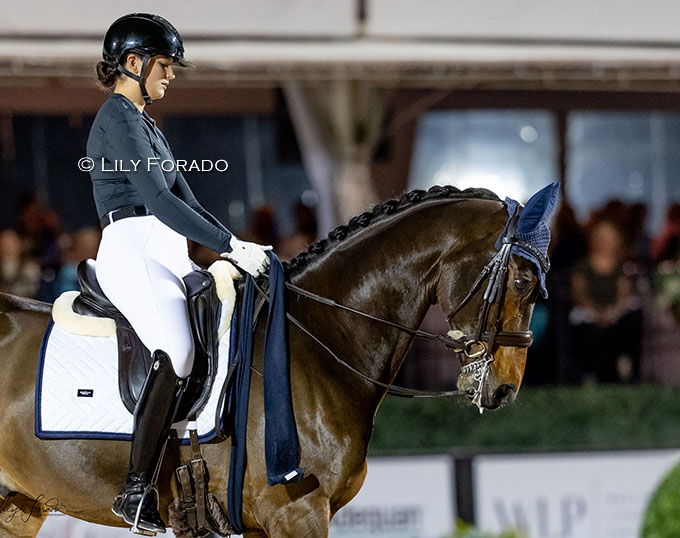
Cathrine once again returned to the theme of contact and feel. She described when a horse is more difficult to sit, allows the rider can find a lower center of gravity. “It’s not about the movement; it’s about the reaction.”
At one point, Kyra summed up what many riders struggle with most: “The three things that are very difficult for a rider are having the horse on the bit, sitting down in the trot, and doing a half-halt. If you can do all three, then you can do Grand Prix.” The audience responded with laughter and applause.
Jan Brink: Rhythm, Line, and Automatism
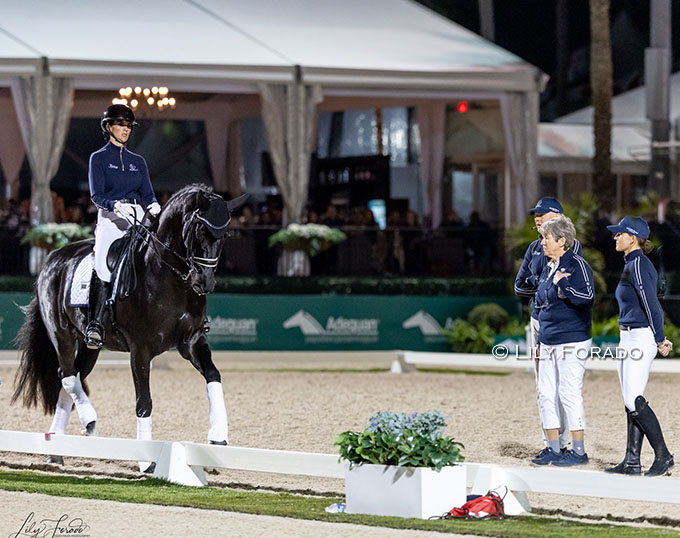
Rebecca Cohen presented Prince of Hope, a 10-year-old Swedish Warmblood gelding by Total Hope x Bellagio, owned by 3 Graces Dressage. Initially tense due to the atmosphere, the horse gained confidence stride by stride through Jan’s guidance, eventually showcasing the quality of his trot. Jan emphasized working on lines—not just movements—as the foundation of consistency.
Jan addressed the importance of the correct use of the double bridle “as coaches we need to educate how to ride with double bridle, how to use the reins, you have to be clever with the fingers, and where to put pressure.”
Advanced Work: Collection and Piaffe
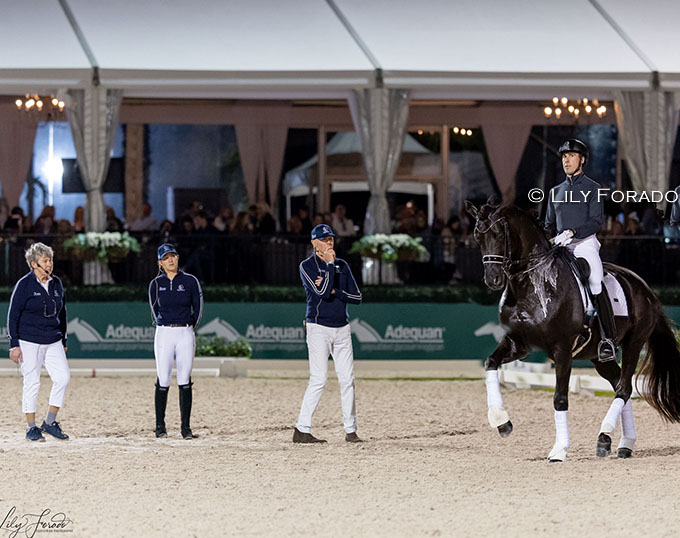
One of the most resonant concepts of the night was Kyra’s explanation of three training zones. “In the first zone: comfort zone, nothing changes. In the second one: stretch zone, learning happens. The third zone is panic zone, where tension overrides understanding and you don’t want to go there. The responsibility of the rider and trainer is to push gently into the stretch zone without ever tipping the horse into panic.”
As the evening drew to a close, Kyra summarized what many riders struggle to articulate: “Feeling is a sense, like hearing, to understand how to feel, you have to experience it. The most difficult to teach in riding is feeling." After the final ride, the three Olympians answered some Q&A.
Related Links
Hof Kasselmann to Present Frederic Wandres Masterclass at 2025 Global Dressage Festival
Jessica von Bredow-Werndl Masterclass: "It is Not How Far We Get, It is How We Get There”
Isabell Werth Masterclass in Wellington: The Golden Words