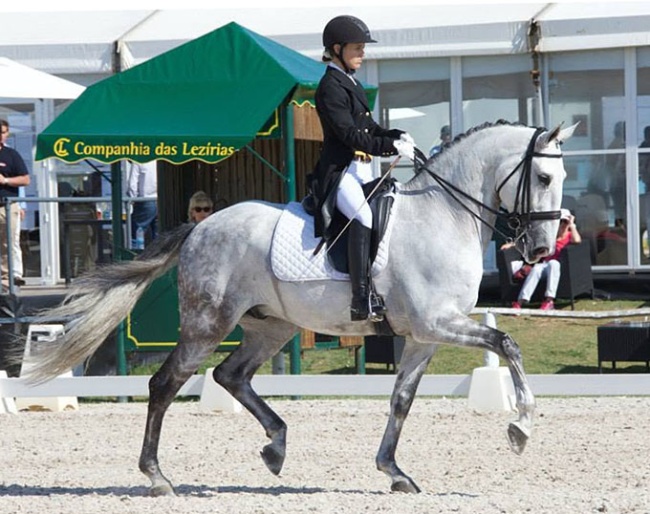
- Text by Sarah Warne-Furtado for Eurodressage. - Photo © Rui Pedro Godinho
Eleven years ago I was competing internationally on a very talented Lusitano as an amateur Iinternational dressage rider. I rode one horse, every day, and took him from a four-year old up the levels, learning as we went. There was a lot of miss, a little bit of hit, some luck, and a fair bit of winging it.
I had ridden all my life but just as everything I had impossibly dreamed of began to fall into place, my body said “that’s enough”. Twenty years of self punishment caught up with me and the chronic pain I had had since I was eleven years old finally got to that point of no return. I write this to help other riders avoid getting to that point. I believe there is a way to avoid it.
The Body Stores What the Mind Cannot Understand
Chronic pain is never just one thing. It is typically a combination of factors. There is sometimes a catalyst and sometimes not. Just wanting to be a perfectionist, with ambition, combined with the desperate need to please people is enough. How many horse riders fit into that category I wonder? My catalyst was guilt that I stored in my body. The body stores what the mind cannot understand. And so it was.
Dressage gave me freedom from self-critique. Strangely, the perfection and harmony required for dressage became a space for my mind to become quiet and when I was training my horse I wasn’t guilty, or abandoned, I was just a girl on a horse, trying to understand him. When the pain got worse I became afraid. I had always been fearless on horseback and now suddenly I was afraid, not of falling but of stopping. A perfectionist cannot stop. A perfectionist has to keep going, no matter what.
The horse knew it. So he too became nervous and the cycle began. Back then, I thought that was fear, but now, with three young children who depend on me and eleven years of no riding, I have a level of fear that for someone who used to gallop across open paddocks and chase hundreds of cattle into yards and crack a stock whip at a gallop, would make my younger self feel embarrassed.
Having Faith
I used to think that to be a good rider you needed to be fearless, but I have since discovered that it is not fearlessness but faith that gives riders confidence; faith in their ability and faith in their horses. When these two things are in balance a rider will seem confident, because their nervous system has weighed the odds.
If you are afraid every time you ride then what is out of balance: faith in your ability, or faith in the horse you ride? Or both? Right now my faith in my ability is close to zero. I am riding horses that I didn’t train for years and I don’t know. My body has laboured three children and grown unaccustomed to the saddle, and beyond that the nagging question, will the old patterns of chronic pubic pain return? All that equals fear.
However, if confidence comes from faith in your ability then how do you increase that faith? I think the answer is mental and physical capacity.
Position
The load we require from riding cannot exceed our body’s trained capacity. Physical capacity is how the whole body works. I think riders go to Pilates and think if they get a strong core then they will be a better rider. Unfortunately this is often not the case. One of the best instructors I ever had used to say, “she is a fitness freak so she doesn’t follow the horse’s movement.” He thought that riders who were heavily core-focused became unable to follow the horse’s movement efficiently.
He hated the term “position” because he said it’s not a static thing you put yourself into, but a functional influence of your body learning to channel and influence and balance the horse. To do this your body needs to be functionally capable. A strong core will just have you sitting solid and ready, but for what? To sit to the trot? To let the energy bounce through your body? Will a strong core help? Not necessarily.
A body that can work as a unit a body that understands how to move. A body that can be relaxed while being coordinated and efficient, is a body that will communicate better with the horse. Then there is mental capacity. If you are highly functional physically, but you have a short fuse and rage issues, then your mental capacity will lower your overall capacity as a rider. If you lack empathy for the horse, equally so.
If you watch an experienced trainer greet someone before a lesson, you can see that they know just by the character of the person if they can ride well. How do they know this? They know because they see impatience, ego, insecurity, and the need to prove something. If instead they see patience, humility, empathy, what can they assume?
Trying Again
I know that there are many riders who have chronic pain, who ride to quiet a relentless mind, and/or are fearful in the saddle. I also know that there is something about riding and horses that is very hard to let go of. I gave it up for eleven years, and the minute I get in the saddle, it becomes my focus point, the thing I think about everyday. I miss horses. They are curious, and clever and they change us if we let them.
So how to overcome fear? One thing is certain you don’t overcome fear by telling yourself it will be ok. You overcome fear by doing it, and every time you do it and it is okay, your nervous system becomes a little less alert and a little more trusting. You overcome fear by increasing the faith in your riding ability and learning about your horse, until the threshold of capacity overwhelms the threshold for what’s required. So first things first.
The internet is now exploding with methods and courses and theories what to do. How to “fix” your position by buying this elastic band, or these gloves, how to “fix” a horse by taking this ten-week horsemanship method, or this special “insert new horse word here” technique. Nothing is wrong with this and there are some excellent resources out there, but if there is anything I have learnt observing over the last ten years it is that dressage riders do way too much, in life and in riding. I am not disapproving of research, reading and planning. I am saying not to over complicate it.
"Ask Little, Reward Often"
Nuno Oliveira said, “ask little, reward often.” I wonder, can we apply the same to ourselves?
I would say for 99% of dressage rider personalities this is more difficult, but riding is getting simple things right, over and over, until they grow into complex things. Riding is one aid at a time, riding is legs not hands and hands not legs, riding is feeling and understanding the horse and where his weight goes.
Riding is being present with these magical creatures, who carry us, metaphorically and physically. Riding is not tricks or methods . Great if you do them, but honestly I am more impressed if you can do a relaxed free walk on a long rein where the horse stretches his neck out and tracks up with a rhythmic, even four-beat walk. Riding is communication between your body and the horse’s body. Learn to communicate simple things well, and repeat.
Whether you are starting, start again, or just start a new day and think as if you rode yesterday, Another fundamental question is: does my ability (capacity) mean my horse is a suitable match for me? This can be a tough pill to swallow as we get older.
A younger me would have gotten on anything, but the older me knows that is unrealistic. Right now, I need a safe, steady schoolmaster to retrain my nervous system. If your nervous system is on high alert every time you ride your horse, are you enjoying it? Is your horse?
Nuno Oliveira used to say you could teach a horse to do a flying change by pulling on his ear if you wanted to. Don’t try it at home, but his point was that horses are incredibly good at learning if we give them clear simple tasks within their capacity, and we make it enjoyable for them. I wonder, can we do the same for ourselves?
Photo © Astrid Appels
Related Link
Training articles on Eurodressage