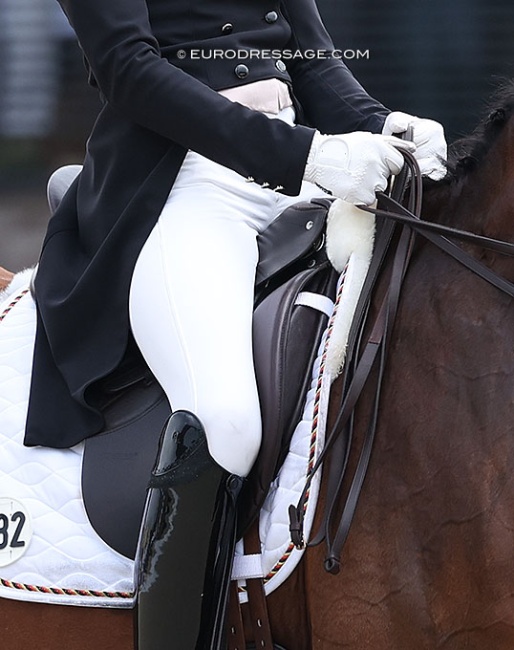
-- by Dave Thind on the the difference between looking correct and riding in harmony.
Imagine watching two accomplished riders. Both sit beautifully upright, with quiet hands, level shoulders and apparently balanced seats. Their positions appear equally correct, and both have worked hard to develop the skills that brought them there.
Yet beneath those outwardly similar pictures, something quite different may be happening. One rider might be using considerable muscular effort to maintain that position, while the other has discovered an organization that allows the same position to emerge with surprising ease.
Neither rider necessarily knows exactly how much more freedom or comfort might still be available to them. After all, we can only work with the possibilities we have learned to recognize. To an observer, the difference may be almost invisible. To the horse underneath, it may be anything but.
At a time when our sport is increasingly examining horse welfare, rider biomechanics, and how both horse and rider can remain comfortable, healthy and performing well for years to come, this distinction deserves our attention.
A recent Eurodressage article, The Rider’s Body: An Overlooked Welfare Issue, highlighted some startling research: 74% of riders surveyed at a four-star competition reported chronic pain, while only 17% used physical therapy and 70% reported taking pain medication. The implications extend beyond rider comfort to performance and, importantly, the welfare of our horses.
These findings raise an important question. We invest enormous effort in improving our horse's strength, suppleness, straightness and longevity, but are we equally thoughtful about how we develop ourselves as riders? Are we teaching riders to look correct, or are we helping them discover how to function well?
Ideally, of course, both. Perhaps the exciting opportunity lies in discovering how much more comfortably, efficiently and harmoniously we could be riding.
Dressage is a Journey, not Just a Test
The beauty of classical dressage lies not simply in the movements we perform or the scores we receive, but in the ongoing process of developing horse and rider together. Two living, learning bodies, gradually becoming more balanced, supple, coordinated and expressive, and discovering how to move together with increasing freedom, ease and harmony.

Dressage riders become exceptionally good at correction. We notice a shoulder dropping, a hip tightening or a leg creeping forward, and our instinct is to fix it: straighten it, strengthen it, stretch it, hold it in place. Accomplished riders can become extraordinarily skilled at making the outside look the way it should. That skill has enormous value. Discipline, technique and strength matter; there is no Grand Prix riding without years of training and physical development.
However, sometimes we don't change the underlying organization that created the difficulty. We simply become increasingly sophisticated at compensating for it.
A pelvis that does not move freely may be hidden beneath a beautifully positioned upper body. A collapsed side may be disguised with muscular effort. A rider who habitually carries more weight on one seat bone may learn to arrange the shoulders so effectively that very little appears wrong from the outside.
Compensation becomes layered upon compensation until the rider looks increasingly correct while working increasingly hard to maintain it. What if improving our riding didn't always require doing more, but sometimes discovering what we could do less of?
“Judges Don't Care How It Feels”
Many years ago, I had a conversation with an accomplished rider whose philosophy was very different from mine. Frustrated by my interest in slowing things down and micro-managing body awareness, she exclaimed, “You can't meditate your way to Grand Prix. Judges don't care how it feels. You get a mark for what it looks like”

Thankfully, our sport has evolved considerably. Riders, trainers and judges are having increasingly thoughtful conversations about welfare, biomechanics, longevity and the experience of the horse. We are, I believe, largely on the same side.
Experienced judges are certainly not blind to harmony; on the contrary, the best can recognize qualities that are difficult to quantify: a horse that appears willing and available, a rider who seems effortlessly influential, and a partnership that somehow makes difficult things look easy.
Yet even the most experienced eye cannot see every unnecessary contraction, compensation or restriction beneath a beautifully arranged rider's seat and position. The horse, however, experiences the consequences.
Could Less Effort Lead to Better Riding?
Rather than immediately correcting what looks wrong, a perceptive rider should explore why his / her body organizes itself as it does. Where is unnecessary effort accumulating? What is another part of the body doing to compensate? Could the same movement become easier if something seemingly unrelated were allowed to participate differently?

There is an important difference between strengthening a rider and strengthening the compensations that rider has learned to rely upon. Riders can find a solution by investigating that difference through awareness, gentle movement, and variation. Instead of repeatedly telling the body what it should do, we give the nervous system opportunities to discover how something might be done differently.
Horses are extraordinarily sensitive to changes in balance, pressure, muscular tone and timing. They feel when our pelvis becomes more available to follow their backs, when a leg stops gripping, when our breathing changes and, perhaps most importantly, when an aid ends. The combination of biomechanics, body awareness, movement therapy, and classical German riding principles can bring a rider to a new level of understanding and riding.
We are not simply working the horse. We are learning to work with the horse. Improving one's seat is no longer an isolated exercise in achieving the correct posture, it is part of an ongoing conversation between two bodies learning to move better together.
Become Better Partners for Our Horses
Each of us develops our own understanding of what ideal riding should feel and look like, shaped by our experiences, our aspirations and the people who influence us along the way. Trainers continually challenge our assumptions, reveal our limitations, and help us discover possibilities we might never have imagined.
In my riding I have always tried to achieve these goals: How little can I do while still communicating effectively? How can I help the horse develop greater balance and self-carriage, without constantly depending on my aids? Can my aids become quieter while their meaning becomes clearer?
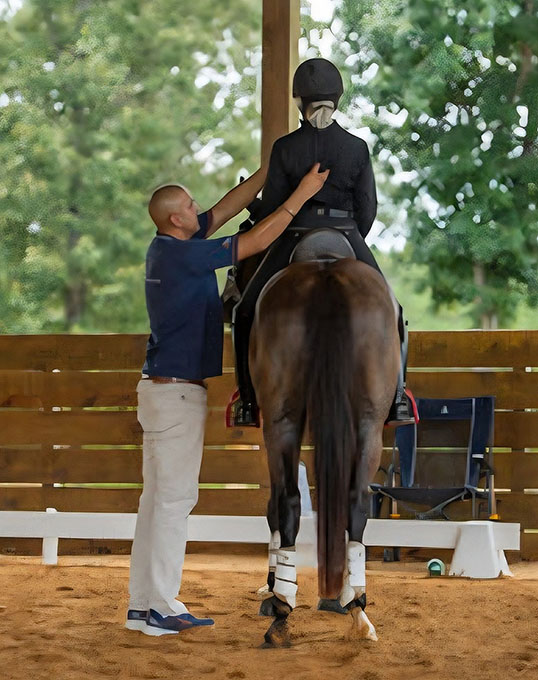
And perhaps this is the most encouraging part: while we share the fundamental principles of classical dressage, each of us brings something uniquely personal to the journey. Different horses, different bodies, different experiences and aspirations. The relationship we hope to build with our horses, the quality of communication we seek, and the kind of rider we wish to become are choices we continue making throughout our lives.
No matter how experienced we are, or how long we have been riding, there may still be easier, freer and more harmonious ways of organizing ourselves that we haven't yet discovered. A beautiful seat need not be something we hold together through endless correction. It can increasingly become the natural expression of better organization, awareness and communication.
Every one of us has a part to play in preserving and advancing this wonderful art. Not necessarily through championship medals, impressive scores or public recognition, but through the way we ride, train, teach and treat our horses every day. Each of us can become a quiet ambassador for good horsemanship and dressage, simply by striving to make the experience a little better for both horse and rider.
- By Dave Thind
Thind teaches Feldenkrais® Awareness Through Movement® lessons to assist riders in retraining how the brain and body communicate, replacing tension with coordination, and over-effort with true effectiveness. He spends winters in Wellington, Florida, and summers in Europe, but travels around the world for private clinics, lessons and body awareness seminars.
-- Photos © Astrid Appels - private