- Text by Sarah Warne-Furtado for Eurodressage
The FEI Dressage Rules state that the objective of dressage is “the development of the horse as a happy athlete in a positive mental and physical state through harmonious education”. Yet the riders in the spotlight, riding down the centreline and receiving the medals, are not necessarily the ones who trained the horse.
Even when they have played a significant role in a horse’s development, they have typically benefit from the guidance of experienced trainers and coaches along the way. So is the sport of dressage rewarding those who fulfil its fundamental objective?
Leapfrog to the Top
To discuss this topic, I asked four-time Olympian, fellow of the International Dressage Trainers Club, and renowned dressage professional Richard Davison, whether you can, in fact, buy your way to the top.
“It depends what we mean by the ‘top’, but yes, you can buy your way so you can participate at a higher level or leapfrog your way up! I’m not addressing what should or should not happen as that was not your question and I will leave that to others to opine on. I am just saying what is currently the reality,” says Davison.

So if you can buy your way to the top, can you simply buy a ready-made Grand Prix horse and become the best in the world? Or is it not that simple? How many incredible combinations have we seen sold off to new riders only to never be heard of again?
If you look at the last ten individual Olympic gold dressage medallists, the overwhelming majority of riders did at least part or all of the training of their horses themselves.
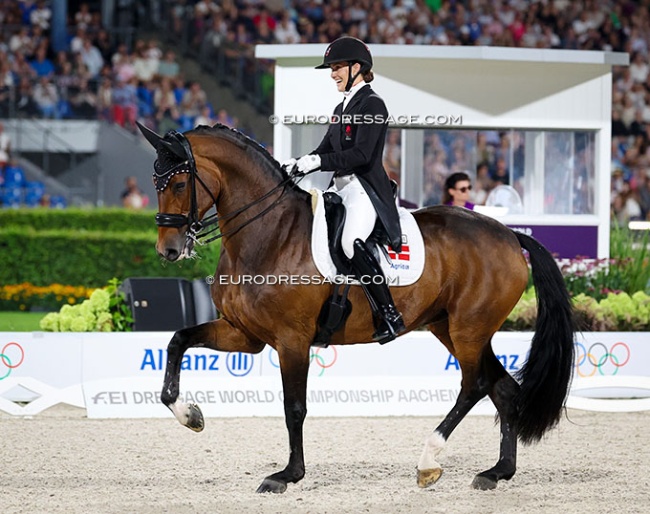
“I think it is dangerous to make generalisations and there is a difference between participating at top level and being successful to the point of winning medals,” says Richard. “Most often, top riders want to train their own horses, at least part of the way. Isabell Werth mentioned that she generally prefers to bring her horses on herself despite having the backing to buy a trained horse. There is something special about training a horse yourself. However, if we look at Cathrine Dufour and Freestyle, they are currently the number one pair in the world and have formed a beautiful partnership. As a rider, the ability to adapt to a top horse’s regime is also a skill. This pair might be the exception, but they also prove that it can be done!”
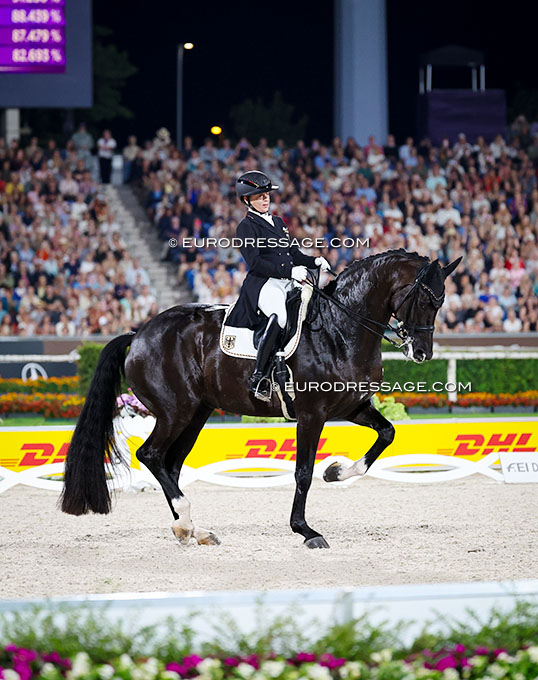
to medals by Werth
The Luxury of Money
According to Davison, money doesn’t guarantee success, but it certainly helps
“Money can be a significant enhancer. It doesn’t matter what level, regional to international, money can buy lovely horses, and money can buy good coaching, good facilities, good grooms, good veterinary care, and other support. All are needed to optimise success,” says Richard.
“However, money is no guarantee. First of all, you need the desire, skill, and ongoing drive to become a better horse person. That is something money cannot buy, and without it your results will always be severely limited. Then you might buy the wrong horse, or pay a lot for the wrong coaching, along with a myriad of other factors which can lead to a lack of success. So money alone is not enough.”

Adrienne Lyle to fine-tune
“The person with no money but with a lot of talent may now get offered a life changing amount for a well-trained horse. Of course this always presents a really tough decision,” says Davison. “I respect it when riders don’t want to sell their horses, but if you have no financial backing, you may need to make those tough decisions to get to where you want to go, whereas a good rider with money has the luxury of choosing not to sell. People who aren’t professionals or don’t have a child in the industry often think it’s terrible that riders choose to sell their horses, but these people often have another source of income. They may not fully realise that these riders often don’t want to sell their horses, but to make mortgage repayments on a house, raise a family, or even cover the costs of running a stable and paying staff, this is sometimes a tough but necessary choice.”
Having begun in the sport when this wasn’t an option, Richard feels that commercialisation is opening doors, giving people a lot of jobs, and a lot of enjoyment working with horses.
“There is now a very good living to be made for young people who strive to become better professionals and want to produce well trained horses for the market,” says Richard.
Hope for the "Poor"
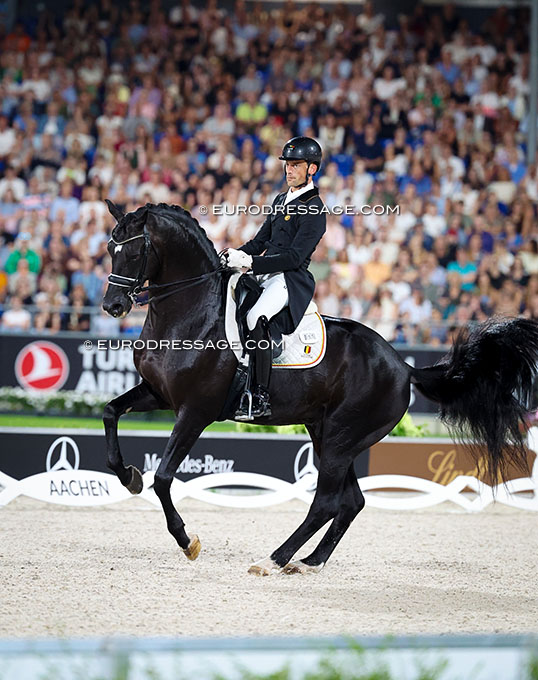
himself without a big sponsor behind him. He
bought the stallion cheap as an unbroken 2.5 year old
“Get to stables, work really hard, and you might be given an opportunity. There are riders at the top who got there in this way. However, often the young riders who idolise them have no idea how hard they have worked to get there.”
If you are good enough and intelligent enough you can find a way, but Richard warns there is always a downside to riding for someone else.
“Some people work their way into an incredible job opportunity and then walk away. It’s not for everyone and that’s fine as everyone should be free to determine their own path.”
On the other hand, if you do have the money and want to buy a horse to take you as far as you can go, how do you find a good horse?
Buying a Top Horse? Test Its Temperament
“Absolutely start with its temperament,” says Richard. “It is not just amateurs who want a good temperament, even top riders need it if they don’t want to start at a disadvantage.”
Riders often associate sensitivity with a horse’s reactions to his environment. So how do we know what is the sensitivity we want, and the sensitivity we don’t want?
“When we say ‘sensitive’, we mean physically responsive to our aids,” clarifies Richard. “Top riders want a horse that moves off a light touch, but that doesn’t have a huge conflict reaction or natural flight reaction. But those horses are often much trickier to handle for less competent riders.”
Richard advises that when you are testing a horse’s temperament try to be creative and a little bit challenging, with the seller’s consent of course.
“Ask if it’s ok to ride him in the outdoor arena or around the stable area past the flapping plastic on the hay bales, or away from the other horses. Try to use your imagination. If you’re still interested in the horse, ask if you can try him at an arena hire venue to assess how he arrives at a new place.”
If you are certain on temperament, which is the absolute non-negotiable, Richard advises to then test his responsiveness.
“Go to halt and walk off. I don’t necessarily want him immediately on my level of sensitivity, but I want to see whether, after the tenth transition, I need less leg or more leg. What sort of brain does this horse have? Even if he was maybe ridden with a lot of leg previously, is there a sign that he will become more responsive?”
Checking to see if the horse will adapt, Richard also looks for the point of compromise.

to commit fully to her career with Parzival
So what can you compromise on?
“It depends what level you compete at and what you are buying for. Study the relevant tests and see which movements are assigned coefficients and have the most repetitions. That will indicate the priorities at a certain level. However, when it comes to the top level, if you want to get on the medal podium, gone are the days when you can compromise on the rhythm of the walk.”
Richard advises a calculated compromise, weighed up with the rider’s ability and goals.
“There is no perfect horse, and if you haven’t found the area(s) of compromise, then you haven’t assessed the horse properly,” he warns.
Winning Medals vs. Producing Horses
So, if you have found that special horse, and you can buy your way into competing at a higher class, but the objective of the sport of dressage is the development of the horse, are we rewarding development or performance?
“Different competitions have different objectives. Some classes or streams are designed to guide and direct development. Examples of those are young horse tests, youth, and lower level classes. However, at the top of the sport, at the European or World Championships or Olympic level for example, in order to gain the integrity of an equivalent main-stream sport, the competition must reward performance set against a transparent criteria or easy to follow set of rules,” says Richard.
Grand Prix under Anne van Olst' supervision
“For most riders, myself included, the pathway to becoming a top rider is gaining experience and feel from a well trained horse. Those with enough money can buy trained horses, learn from them, and some then eventually decide they’d like to learn how to produce a horse from an early stage of training.”
Unfortunately, the downside of the commercialisation and demand for trained horses, is that horses are often rushed up the levels, but Richard warns that this happens regardless of sale value.
“Even without the prospect of a lucrative sale, horses have always been rushed because of the ambition of the rider,” says Richard. “Take the young professional, everybody is in a hurry. It is nothing new to rush horses. It’s not new to be in a rush with everything when you’re young is it? However, experience teaches you it is counter-productive to rush the early stages of training.”
So if we accept that the sport at the highest level currently rewards performance, could more be done to promote correct classical training as a basis for future dressage stars?
Could We Better Recognise the Producer Alongside the Rider?
“Yes of course!” says Richard. “I think this is really important. To see the coach and trainer recognised for producing those horses, getting them to small tour or big tour level, including children, youth, or para classes, in a good and ethical way, so they are ready for a rider with the finance to buy them. We should absolutely reward and acknowledge those who achieve this.”
Perhaps initially those people could be given mention. Imagine if you could look at the starting list for a world championships and note that three of the 90 combinations were trained by the same coach. Imagine watching the riders and taking note that those were the three riders you felt showed a beautiful connection to the horse and a soft, elastic way of going. If the start list began listing who had trained those horses to medium or advanced level, and those trainers began to be seen more regularly, dressage riders could then know who to follow, or who to go to for their next lesson.
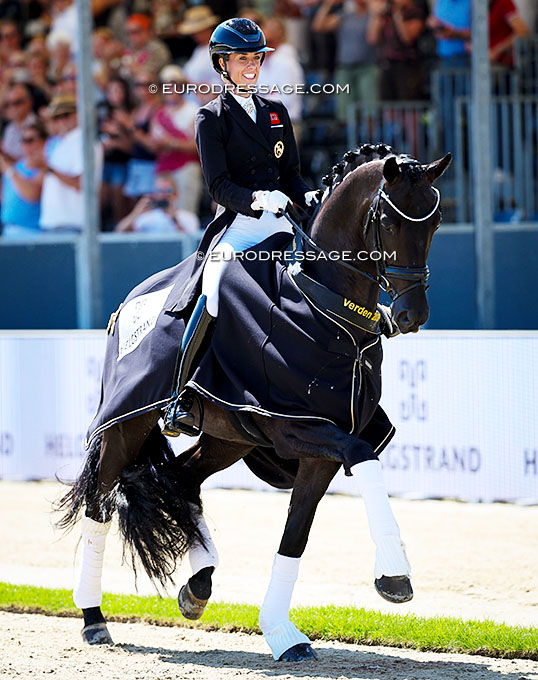
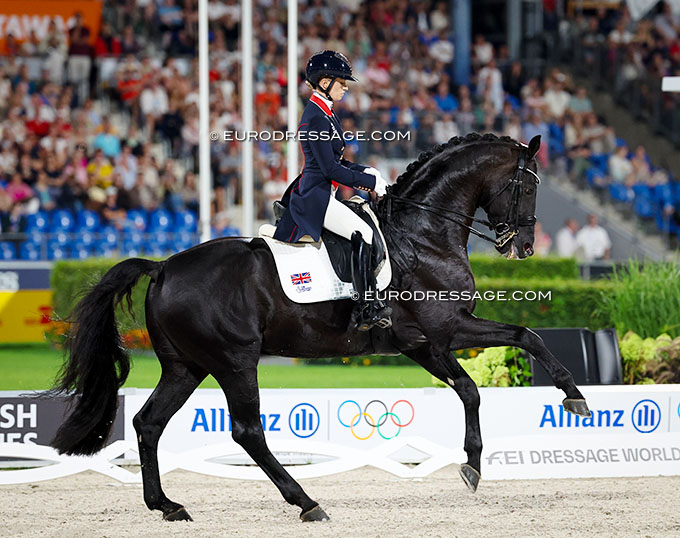
Charlotte Dujardin. Despite all the controversy,
she trained Gio, Imhotep, Alive and Kicking
and Freestyle to GP who are now
all successful under different riders
But how could the sport recognise the contribution of the producer without diminishing the achievement of the competitive rider? If one rider spends ten years producing a horse from young horse classes to Grand Prix, while another purchases a horse already trained to Grand Prix, should those achievements be viewed as equal?
“They are not equal. One person has spent eight or so years training that horse, while the person with the money has had to do what they had to do to earn the money but still had to learn to ride and present the horse. Both scenarios require slightly different sets of skills, although with the commercialisation of our sport the skills can overlap,” Richard explains.
Both pathways require considerable skill, but perhaps it is time the sport formally recognised them: the rider who produces a horse from preliminary to Grand Prix, and the rider who purchases one already trained to that level.
Award the Producers
Imagine an Olympic award for the first combination to have competed at every level, from preliminary to Grand Prix, on the same horse. Or perhaps special recognition for the highest-placed rider who had produced their own horse?

produced can hardly be counted
“Why didn’t we think of that before?” says Richard. “We absolutely could do this. We could possibly have two different awards, one measured on success considering the combinations that won medals at a championship, and perhaps another to the coaches of non-medal winning horses. The International Trainers Club could nominate candidates and this could be from para-dressage too.”
By recognising the people who spend their lives contributing to the development of dressage, we could essentially promote better training and also give credit to those doing a good job.
“Once you give people recognition then you make them a bit of a role model, so they step up even more and influence others behind them,” says Richard. “They could also come into the International Trainers Club and a big part of that is education. Shared learning can help the adoption of ethical, evidence-based training methods, making everyone accountable, and promoting positive practices. This definitely should be at the top of our to-do list! We have brought in the owners and the grooms, so yes, the horse trainers and coaches are next!”
Photo © Astrid Appels
Related Link
Training articles on Eurodressage