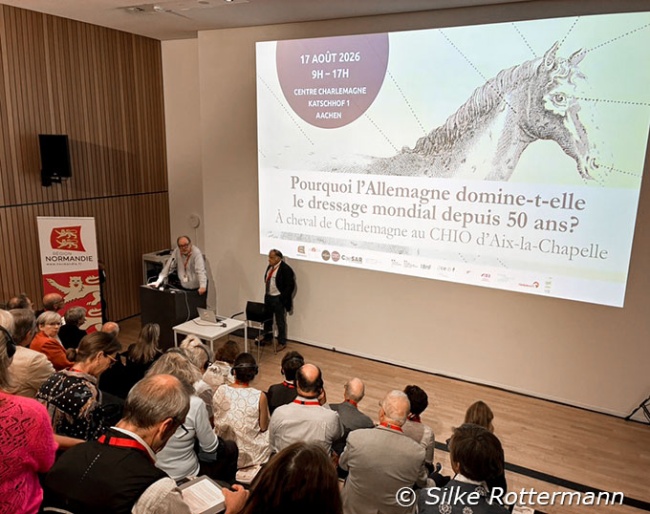
-- Text and Photos © Silke Rottermann for Eurodressage
This seminar report is a continuation of Why Has Germany Ruled Over The World Of Dressage For The Last 50 Years? Part I
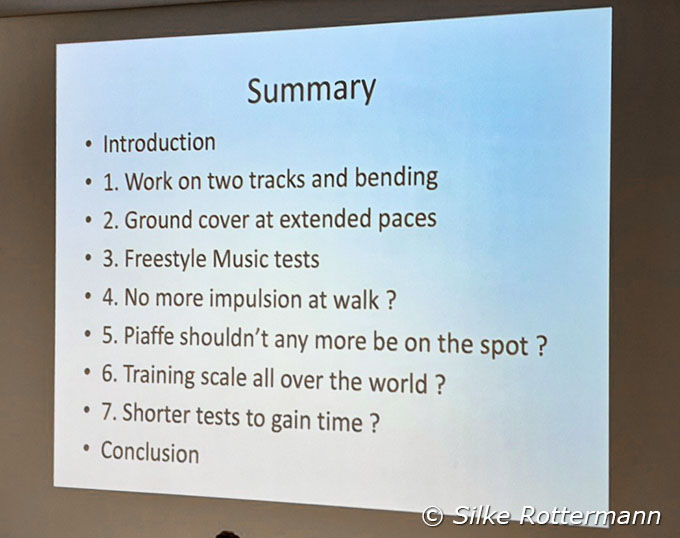
For the final aspect of the seminar the political dimension was to be addressed by using selected examples from the development of international dressage rules. Former French Olympic judge Bernard Maurel chose seven points for this purpose, briefly outlining the development of the according rulesand following each with one or sometimes several related questions, to which Germany’s national coach Monica Theodorescu was invited to react.
Regrettably, several of the selected discussion points were the subject of debate for many years, and various parties had already expressed their views on them in detail. While the interaction between Maurel, Theodorescu and Kyrklund still was interesting and well worth listening, as a passionate follower of international dressage, one would have liked to see some, more current topics of discussion the discipline has to offer, such as the introduction of the stretchy circle in international Grand Prix tests, which is currently the subject of heated debate, or the discussion about the double-bridle. Fortunately, both Kyra and Monica brought up this former topic on their own and presented their points of view.
Monica went on to address the problem, however, that even the judges themselves do not act unanimously. "When do we start to talk of lateral and what is it? Some (judges) give a 6 when for me it definitely would not be a 6. Others are stricter on it and say it is not a clear 4-beat, it is a 4 and if it is really lateral it is a 3. It's the slowest movement and you have enough time to see it, but still judges are not unanimous." She added, "of course I didn’t have the chance to see all tests last week, but many , and there were few here who did it absolutely properly relaxed and coming from a relaxed 4-beat-rhythm, collected, to the piaffe: These were Catherine (Dufour) and my Katharina (Hemmer).“
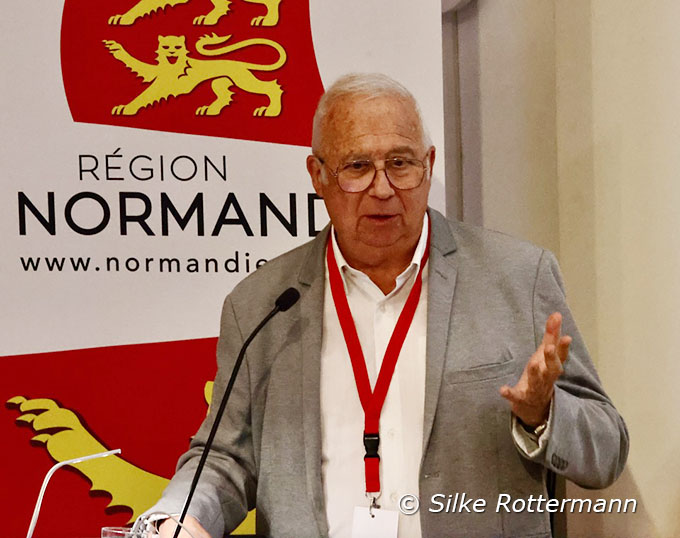
A topic that has been discussed at length and time and again is whether the piaffe should be performed on the spot or rather, how far a horse is allowed to step forward while performing it. In his PowerPoint presentation, Maurel showed that the 1967 FEI rules required the piaffe to be performed on the spot, whereas this wording was softened in 1999 to state that the piaffe should give the impression of being performed on the spot. Logically this has led to many discussions among judges about how far a horse is allowed to step forward.
Maurel asked Theodorescu what she thought about this definition and its lack of clarity. At the beginning of her response, Monica first shared her own definition: „In my understanding the horse in the piaffe should always give the impression of moving forward with the hind-legs moving under and forward. Otherwise it gives the impression of up and back, forward and back, but if the piaffe gives the impression of supple, under and a tiny bit forward for me this would be the perfect piaffe.“
Monica continued to mention the well known problem that riders try to achieve and ask the horse to piaffe on the spot when the necessary balance for it is not (yet) there. „Sometimes we see a horse, because the rider wants to really have the piaffe on the spot and really asks for it, that tries to find the balance and then sometimes is having a step back to balance the whole thing. If the horse is not perfectly balanced and in self-carriage, it has to do something to find the balance.“ Monica emphasized that a horse can make so many different mistakes in the piaffe: from swaying to a three-beat rhythm to leaning on its forehand, but that there is always a reason for them. "Learning every day and seeing horses, the reason for every kind of mistake is because people start to soon bringing the piaffe on the spot.“
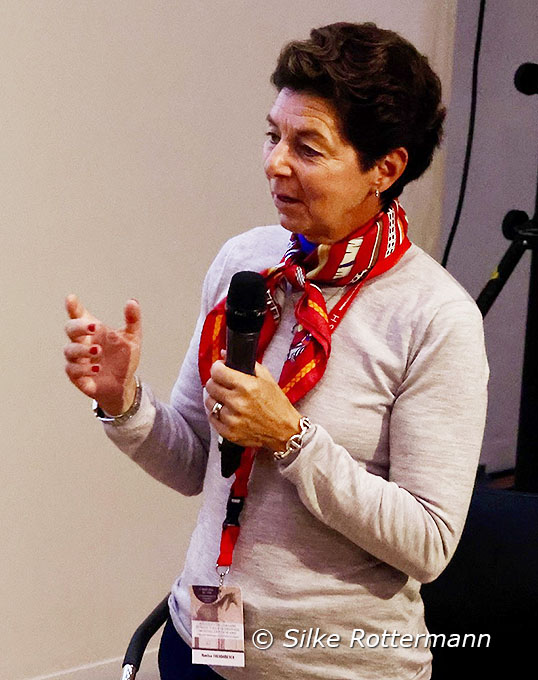
One issue that was a source of heated debate for many years and is repeatedly cited as a reason for keeping the sport in the Olympic program is the shortening of programs to save time. Monica, who is well known as a representative of traditional values in modern sport, took a clear stand on this issue. „What we suffered with all the bad images and bad reports was actually the result of, I personally think, not a great time for dressage when spectacular movements and tense horses were promoted because dressage should be spectacular, it should be for the crowds. There was also the ambition to have shorter tests because everything should be quicker. The GP test, all the tests, became much shorter the past 50 years, much shorter. In my opinion and also the opinion of many riders the so-called short GP put more stress on the horses, also the public didn’t like it and actually it didn’t help the sport.“
Bernard Maurel then asked Monica what she thought about the fact that some judges would like to see the collective marks re-instated, after they were reduced from four to one in 2018. Theodorescu replied, "we still have collected marks in Germany and I think they’re useful. If they’re not used in the correct way that’s not the fault of the marks, it is the fault of the ones who use them and how they interpret them.“ Monica even went further by stating that „to me it is actually central to start to have the view on a test coming from the training scale and not only the technical presentation of the exercises. If a horse is not loose, not relaxed, not happy, everyone can see it. 45 000 people can see it if a horse is uncomfortable, if it’s stressed and tense. But maybe not the difference between a good and a very good piaffe. If a ride is harmonious AND correct it is very good. We need to have even more emphasis on harmonious riding and a relaxed and happy athlete. And if we need more tools in the test to promote that then we will get there.“
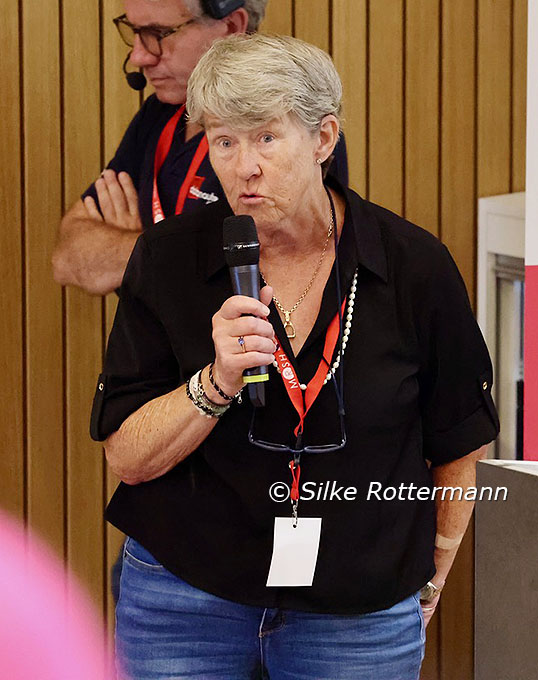
Kyra Kyrklund has clearly advocated for this movement and she used the colloquium to once again highlight its benefits „The stretching at the end of the program was introduced in Denmark in all classes. A lot of the riders, even the top riders, were actually surprised how difficult it was. But actually the horses werde doing better piaffe and passage on the centre-line after being stretched and after being relaxed. So for me I don’t think that’s a boring exercise, it is a beautiful exercise that actually shows everything we want to show.“
Kyra then pointed out the Danish system, which includes various collective marks at the end that are assigned relatively high coefficients. As examples, she cited the quality of riding, the horse’s throughness and the horse’s mouth. The advantages of such a scoring system are obvious when it comes to promoting good, harmonious riding and that is exactly what the sport needs. It might also help if dressage were less of an “material class” and put the focus more back on the quality of training.
As always, of course, all of this depends on how strictly the judges adhere to the guidelines. Kyra summed it up by stating: „Actually if you come in and you ride a normal horse that is going really nicely, carrying himself, doing everything, they can go up in the points. And if somebody comes in, has a spectacular test, but the horse is very tense, they go down in the points.“
The 6th Colloquium of the Bibliothèque Mondiale du Cheval provided a comprehensive overview of the reasons behind the success of German dressage over the past half-century. However, it also showed that other, much smaller nations have made significant progress in both breeding and riding. Kyra Kyrklund highlighted in particular Germany’s northern neighbour, Denmark.
Just as the CHIO in Aachen, rooted in a rich tradition, has remained at the forefront of the global equestrian show circuit through innovations, German dressage, based on its incomparable tradition, must continue to evolve in order to maintain its leading position also in the future.
-- Text and Photos © Silke Rottermann for Eurodressage
Related Links
Eurodressage Coverage of the 2026 World Championships Dressage
Why Has Germany Ruled Over The World Of Dressage
For The Last 50 Years? Part I