-- Text © Angelika Frömming for Eurodressage - edited by Silke Rottermann
“Nothing is more constant than change.” This wise saying by the Greek philosopher Heraclitus of Ephesus applies not only to the all-encompassing events of the world, but also to the routine revisions of national and international dressage tests.
At the moment there are discussions regarding the revision of the Grand Prix test. A particular point of discussion seems to be the inclusion of the "giving and taking of the reins” movement, most often executed on a (half) circle. In this context, the question naturally arises what this movement intends to assess and whether there is actually a need to ask for it in the most difficult test for competitive dressage.
What does this movement ideally look like according to FEI dressage rules?
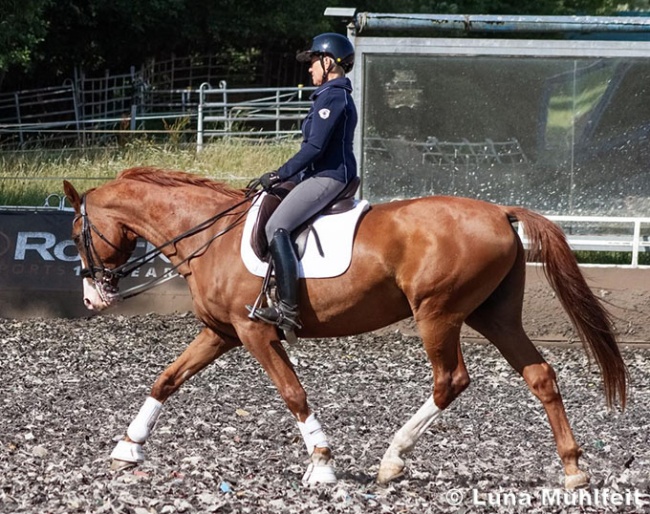
When allowing the horse to stretch the neck, the reins are progressively lengthened while the horse continues to actively engage his hindquarters and extends confidently over the back toward the hand. Only this way the horse’s neck drops from the withers and it is avoided that the horse drops onto his forehand.
It is essential that a constant connection to the horse’s mouth is maintained throughout. The horse’s neck extends forward and downward until the mouth is level with the shoulder point. The head consistently remains in front of the vertical.
During the entire movement the horse maintains his gait, rhythm, tempo and balance.
What is being assessed when the horse is allowed to stretch his neck?
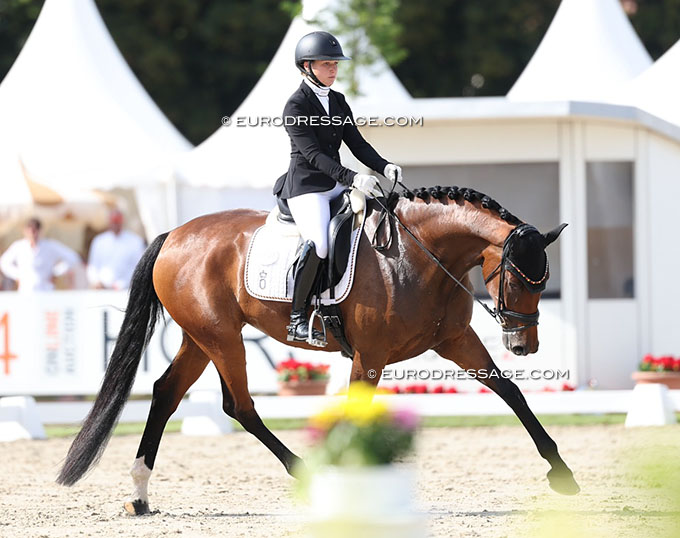
finals test at the 2025 World Young Horse Championships
This movement assesses the horse’s willingness to extend in response to the rider’s gentle hand and the associated swinging unrestrained back muscles. This movement should be repeated frequently, especially during the warm-up phase, to prevent possible tension. In principle this also applies for the subsequent working phase.
With engaged hindquarters this exercise has nothing to do with the horse falling apart or leaning onto his forehand. Instead it involves a state of suppleness that leads to elastically swinging muscle chains and thus to the positive tension which is necessary for any sportive performance.
Still the question remains...
Should this moment be required in dressage tests for more advanced dressage horse?
Perhaps it is not widely known that dressage horse tests for seven-year-old horses specifically require this “giving the reins“ in order to allow the neck to stretch. After all, these horses are already performing exercises at the advanced level.
At the annual selection trials for the World Championships for Young Dressage Horses and at the World Championships themselves, it is striking that this movement in particular has led to significant improvements. These improvements apply not only to the „giving the reins“ per se, but especially to the quality of the transitions and the naturalness of the movement in the collected trot. The collected trot in seven-year-old horses today thus exhibits a more natural, i.e. is an elastic, springy cadence, than it occasionally had been the case before the introduction of this movement.
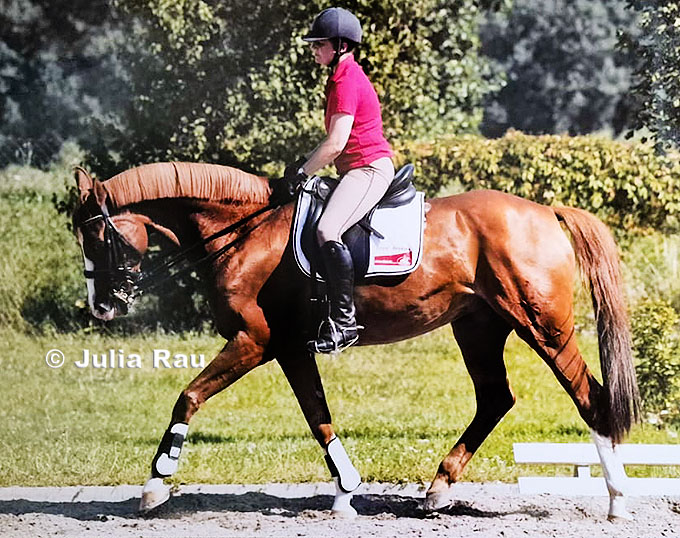
For this reason, it is useful for both the riders and the judges to have this movement included in a test: both at young horse level and Grand Prix. They can assess if the horse will stretch into the contact, also in a competition environment. It keeps in rhythm with the motto: "what is required in a test, will be practiced at home."
Since I have had the privilege of serving repeatedly on committees since the 1970s, I can confirm that, as a rule, usually nothing was added or removed lightly or without good reason. It should always be done based on the principles of classical riding. The aim was always to improve something or make things easier for horse and rider. For example, riding the extended trot on a circle and performing the canter pirouettes to the left and right immediately one after the other in a freestyle were prohibited.
The decisive factor was always improving the training of the horses and improving the riding in general.
Giving the Reins in a Grand Prix Test
Of course, in a discussion about introducing “the giving and taking of the reins” in an Olympic dressage test, one should not ignore the arguments that might speak against it and see if they’re relevant.
The following points have been repeatedly raised on social media:
- the lengthening of the Grand Prix test and the associated problem that it would become even more boring for the general public.
- the risk that dressage might be removed from the Olympic program as a result.
The first point is a matter of scoring. If for example the new movement were assigned a coefficient of 2, like in the 7-year-olds’ test, that could be effective. Furthermore it might be very interesting for spectators to see that even in the most difficult programs, an effortless change of the horse’s posture is possible, thereby clearly highlighting the quality of the training.
Of course it is essential both of these points must be communicated appropriately to the general public.
In my opinion, the risk that dressage might be removed from the Olympic program due to the Grand Prix, which many find boring, is more than annulled by the tremendous interest in the Grand Prix freestyle anyway.
Absolutely crucial is that we pay much closer attention to ensuring that in all leisure activities involving horses and in all competitive equestrian sports the welfare of the horse gets clearly prioritized and in a way that is understandable to the general public. Only then can we expect equestrian sports to remain an Olympic discipline for a long time to come.
I believe allowing horses to „stretch the neck“ by including the movement of "giving and taking the reins“ in the Grand Prix is another right step toward horse welfare. That is why I support this change.
Photos © Astrid Appels - Julia Rau - Luna Mühlfeit
Video © Wehorse
Related Links
Angelika Frömming on the Loss of Quality in Gaits Seen in the 7-YO Dressage Horse Class
Angelika Fromming & Hannes Müller: "Change of Priorities - Training Scale over Quality of Movement"
Angelika Frömming: "To Win or Not To Win, That is the Question"
Fromming & Stammer Seminar 2021: Nuggets of Wisdom from Angelika Fromming
Fromming & Stammer Seminar 2021: "The Nature in Training"
Trainining with Frömming: "Getting a Classically Schooled, Yet Incorruptible Eagle Eye of a Judge"
Angelika Fromming: Open Scoring and Expert Commentary to Popularize Dressage