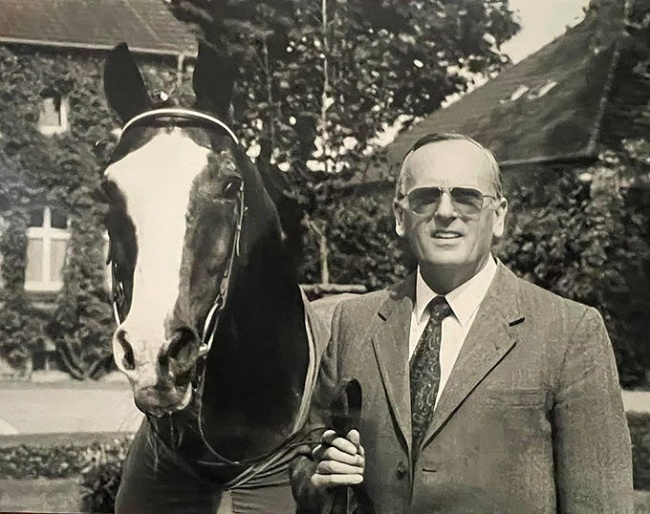
-- Text © Silke Rottermann for Eurodressage - Photos © private archive Lehmann - Rottermann
This article is a continuation of Dr Gerd Lehmann: A Groundbreaker for Modern Westfalian Breeding - Part I
"A New Broom Sweeps Clean"
In Germany, when there’s a change at the top, people often say, “A new broom sweeps clean.” In Dr. Gerd Lehmann’s case that was indeed true. Already in his first year as stud manager, in 1965–1966, he initiated several well-considered innovations that were welcomed by the breeding community.
For example, he introduced a new Westphalian brand mark for warmbloods, designed by the father of his newlywed wife, Sabine, who, “was a horse lover and was very understanding of the fact that I was on the road so much.” It was first used in 1966 and remained in use until the prohibition of branding in 2019, eventually becoming a hallmark of the breed.
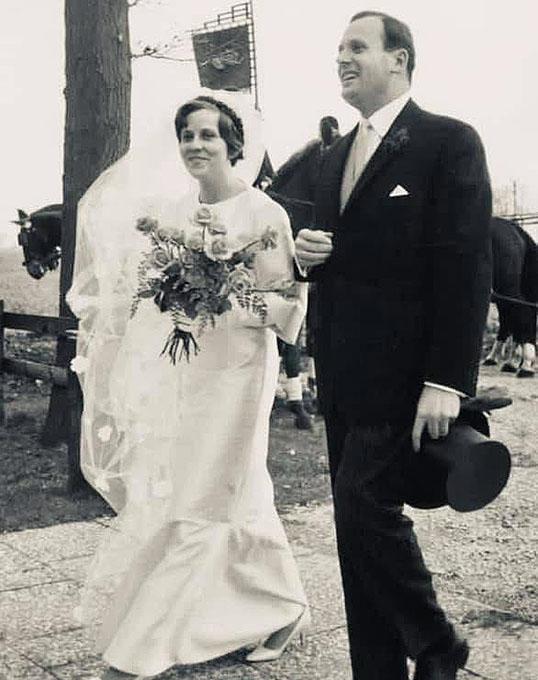
Linnemann who became the backbone of
his professional career and life
At the stud farm itself, which now housed fewer stallions than before, one stable part was re-converted. While the building was previously occupied by a riding club which pulled out, the stalls were replaced with boxes, and the installation of water lines made way for practical automatic waterer systems, eliminating the task of carrying buckets.
To provide greater clarity and comparability, Lehmann organized a central mare show in Münster just one year after taking office, an event that still takes place today under the name “Elite Show.” Fully aware of the enormous importance of a strong foundation of mares for the success of a breeding program, the young stud manager deemed it essential to award the coveted state premiums exclusively at this event. This allowed for a much better comparison of the mares than previously possible at various mare shows.
The mares could also optionally be presented under saddle in a material show to demonstrate their rideability. This was a first in the Federal Republic of Germany and was practiced for several years before the option was discontinued.
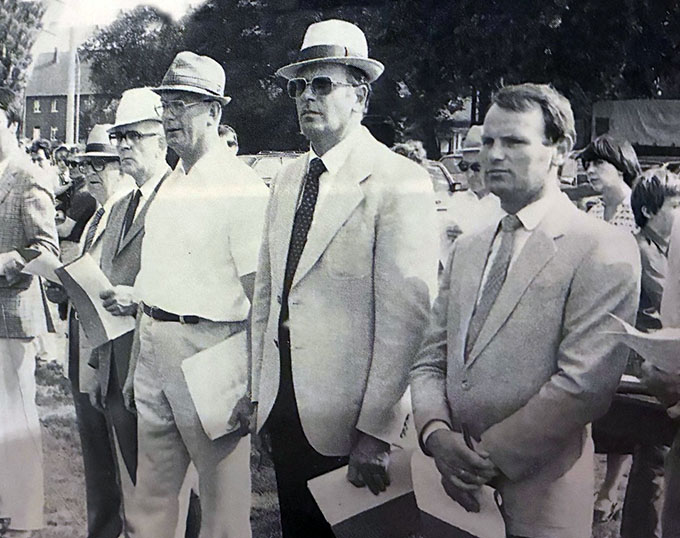
the mare shows he attended
Knowing the great importance of mares to breeding success, Gerd Lehmann requested, shortly after joining the state stud, that a so-called “mare health service” would be introduced, a practice that had already been common in his native East Prussia before the war. The aim was to have breeding health examinations of broodmares during the breeding season between March and July and to advise breeders on matters such as how to feed pregnant mares as well. The Mare Health Service, which was finally implemented in 1969, soon had a positive impact, resulting in increased pregnancy and higher foaling rates. Moreover, following a negative experience, Lehmann also arranged for his stud farm stallions to be fully vaccinated, which was not yet common practice at the time.
Two Hits Right At The Start
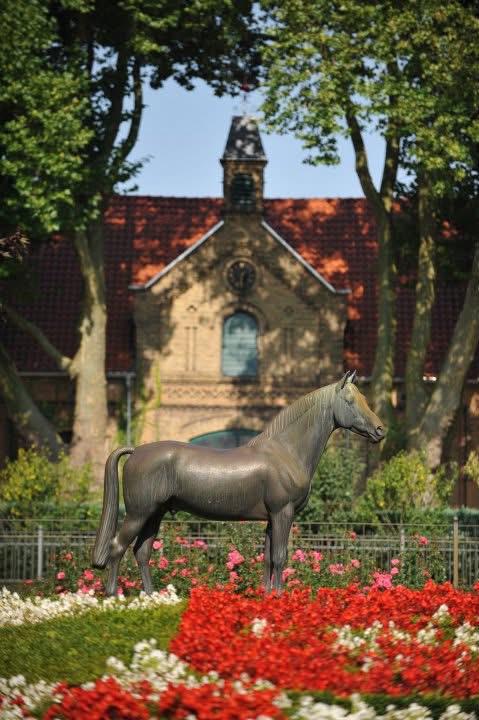
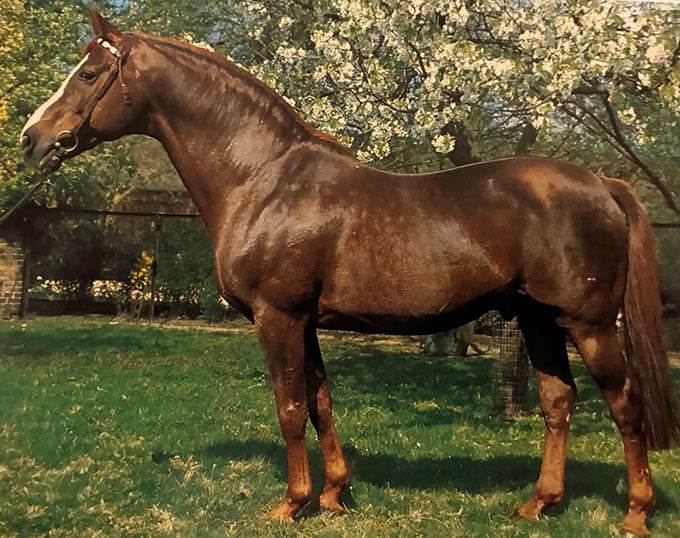
Contrary to the opinion of some experts who weren’t convinced of Paradox I, Lehmann secured the noble, glossy chestnut with the broad blaze and thus scored his first major success. Over the course of the following nearly three decades, Paradox I rose to become an absolute star stallion and became known as “Westphalia’s first prize-money millionaire," money won by his offspring.
That same year, Dr. Lehmann acquired the German-bred bay thoroughbred Angelo xx (by Oliveri xx – Neckar xx), at 170 cm an exceptionally tall representative of his breed, who would attract attention both as the sire of licensed stallions and as a producer of dressage horses.
From the very beginning Lehmann proved to be someone who made absolutely no compromises whatsoever regarding the correct conformation of the mares and stallions he evaluated, judging them against nothing but the ideal breeding goal. He was deeply convinced that only correctly built horses would prove their durability in the long run. This attitude not only bore fruit, but is one that we sometimes wish we could see more often in breeding today, as one cannot help but feel that, nowadays, given the right gait potential, a blind eye is turned to certain flaws.
Well-Thought-Out Refinement
Improving a breed through thoroughbreds has always been a promising approach, but one that requires a high degree of expertise when selecting the parent animals.
The Westfalian State Stud was certainly fortunate to have Dr. Lehmann, a thoroughbred lover who always kept the solid Westphalian mare foundation in mind when selecting future stallions. In 1976, Lehmann was even appointed to the Breeding Commission of the German Directorate for Thoroughbred Breeding and Racing, which only served to reinforce his reputation in those circles.
The breeders, on the other hand, respected their stud director, who was able to give them excellent advice on selecting a suitable thoroughbred stallion. This soon became evident in the horses they produced, which also attracted increasing attention in the sport.
Dr. Lehmann was aware that his targeted breeding adjustments would relatively quickly lead to horses that met the new market’s demands: rideable, attractive, and well-moving with more elasticity. In this regard, the stud manager always emphasized that only a relatively small percentage of these new breeding products would find their way into elite competition, while the rest would become pleasant leisure partners for their riders, so keeping the naturally good temperament was just as important. This insight is more important today than ever, yet it is more frequently ignored in modern breeding, driven by the hope of producing the next expensively sold auction star or future Olympic champion.
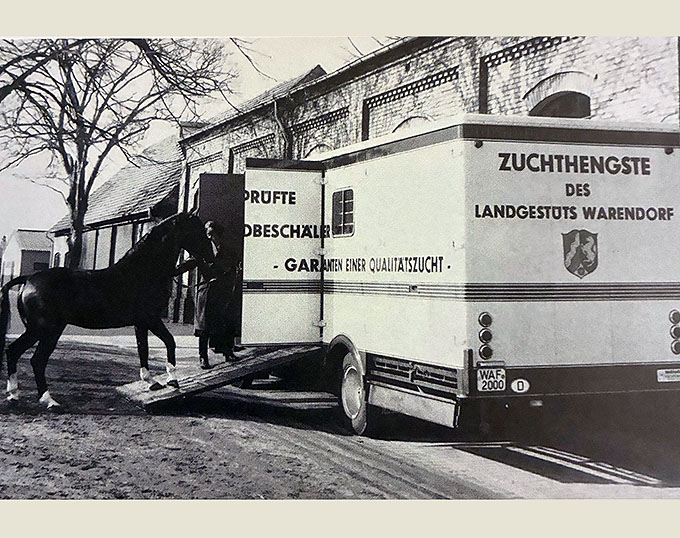
in spring to be transported to one of the
stud’s covering stations
In the interview Lehmann gave to Eurodressage in August 2026 he did not forget to mention his wife Sabine when it came to the thoroughbreds he purchased for the state stud in the course of many years: "when it came to the thoroughbreds, I also benefited from my wife’s expertise. As a petite woman, she rode the thoroughbreds after they were purchased and always prepared them for riding herself. The stud farm staff, in particular, really appreciated that back then," Dr. Lehmann stressed in his conversation with Eurodressage.
XX Success in Sport
Through the use of sires such as Sinus xx, Angelo xx, Windesi xx to name just a very few the elasticity, rideability, beauty, and in particular the physical stamina of these new Westphalian half-breds improved significantly in the years to come. These qualities soon led to remarkable successes in all three Olympic equestrian disciplines. The Westphalian breeding region had already produced its first world champion in dressage in the year of Lehmann’s debut at the state stud, the snow-white Mariano, ridden by Josef Neckermann. He had been bred at the private Vornholz stud, which, as mentioned earlier. This stud focused exclusively on breeding sport horses since the late 1930s and could thus considered an exception.
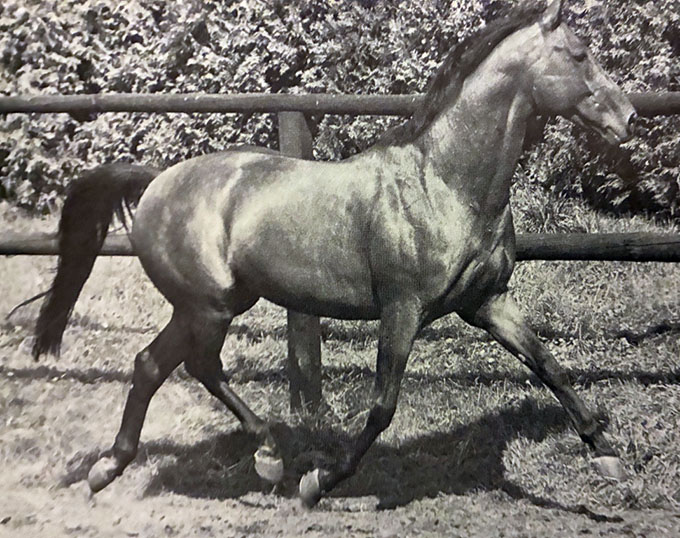
The full brothers Amon (Annemarie Sanders-Kejzer) and Ahlerich (Dr. Reiner Klimke) carried on the legacy of their sire, Angelo xx; both enjoyed international success in dressage well into old age and competed in three Olympic Games, a testament to their breeding and training.
However, the use of selected thoroughbred stallions should not be aimed solely at sporting success, but also at improving the mare population. Lehmann always emphasized that this could only be achieved “through a balanced proportion of thoroughbred blood.”
The demand for thoroughbred stallions not only in the North Rhine-Westphalia breeding region, but in entire West Germany rose significantly. The figures confirm this: When Lehmann took office in 1965, the number of coverages with thoroughbreds stood at just 3.2% and rose to an excessive 14% by 1973—based on the golden rule that anything above 10% is not beneficial to any breeding program in the long run. Accordingly, because of the excessive number of thoroughbred coverages in the 1970s, Lehmann warned against jeopardizing the good temperament and big frames of the Westphalian warmblood, as can be read in the book „Pferdezucht im Wandel“ („Horse Breeding in Transition“), which was published on the occasion of Lehmann’s 25th anniversary of service at the state stud.
The Warendorf Model
Lehmann, who also served as a judge in various disciplines from the late 1960s on, was far too forward-thinking not to realize early on that the existing method of evaluating stallions’ performance no longer suited the type of horse that breeders were now aiming to breed.

Dr. Lehmann was well aware of this and therefore developed a three-stage stallion performance test, which, under the name “Warendorf Model,” gained recognition far beyond the state’s and country’s borders. Between the ages of 3.5 and 4.5 years, stallions were successively subjected to a pulling performance test, a novice dressage test, loose jumping and an elementary riding horse test. In addition, the training director assigned a training grade that covered eight relevant aspects.
In 1980, the Warendorf Model, solely due to a law, was replaced by the 100-day test, which had long been the standard then. Lehmann, however, proposed a test with different riders, in which various riders train the stallions, and emphasized in particular that women must be included among them, since they were already in the majority in the saddle at that time.
"At that time I was asking a young Monica Theodorescu and a likewise young Bettina Hoy (née Overesch) to act as riders. They had both lots of feeling," Lehmann reminisced.
Boosting The Rinelander Breed
Even though the list of achievements that Dr. Lehmann introduced and brought to fruition during his 30-year tenure in Warendorf is long, there is one more thing that must not be overlooked.

Gerd Lehmann also took up this cause and made efforts to involve the breeders of the Rhineland more closely, who, in the early days, were primarily breeders of draft horses. In doing so, he not only succeeded in convincing some of them to breed riding horses in the future, but he also established more breeding stations in the Rhineland to give this reason a boost and significance.
In 1973, he purchased the Rhineland stallion Pasternak (by Patron x Wortschwall), born in 1971, as the first representative of his breeding region for the State Stud, with many more to follow ever since.
Of particular note here is the legendary and unforgettable dressage sire Florestan I (by Fidelio x Rheingold), bred by Eberhard Schulte-Böker. Dr. Lehmann was able to acquire this legendary stallion for the State Stud at the 1988 main licensing. His offspring and their offspring have thrilled audiences for years in both elite and recreational sports, and with 97 licensed sons, he has left behind a rich legacy and is considered one of today’s rare line founders.
Part III coming soon
Related Link
Dr Gerd Lehmann: A Groundbreaker for Modern Westfalian Breeding - Part I
Florestan I Passed Away
Florestan Celebrates 25th Birthday
Reference List
- Conversations with Dr. Gerd Lehmann in August 2026
- Hermann Kothe, Vollblut in den Landeszuchten - Ist Härte nicht mehr gefragt?, in: Sankt Georg 10/82, Seiten 50 - 57.
- Knoll, Lore, Preuße alter Schule, in: Sankt Georg, 12/83, Seiten 66-69.
- Hans-Joachim Köhler, Vom Wirtschaftspferd zum Leistungssportler, in: Sankt Georg 12/84, Seiten 36 - 40.
- Franz-Josef Neuhaus, Zuchtschätze, Bedeutende Stutenfamilien in Westfalen, Münster ohne Jahr, Seiten 186 - 205.
- Jasper Nissen, Geht der Zucht der Saft aus?, in: Sankt Georg 4/2000, Seiten 13-17.
- Reiter und Pferde in Westfalen (Hg.), Pferdezucht im Wandel - Festschrift für Gerd Lehmann, 25 Jahre Landstallmeister in Warendorf, Münster-Hiltrup 1991.
- Rolf Schettler, Hengstauswahl - Zuchtfortschritt mit bewährten Alten oder modernen Jungen?, in: Sankt Georg 11/85, Seiten 52 - 53.
- M. Stoffregen-Böller / F.-J. Neuhaus / O.Marré / H. Heuoel, Westfalen-Die Jahrhundertpferde, Münster 2004.
- Michael Stoffregen-Büller, Die Heimat der Hengste: 175 Jahre Warendorfer Landgestüt, Münster-Hiltrup 2001.