-- Text © Silke Rottermann for Eurodressage - Photos © private archive Lehmann
This article is a continuation of Dr Gerd Lehmann: A Groundbreaker for Modern Westfalian Breeding - Part II (also read Part I)
Reaping The Fruits Of Labour
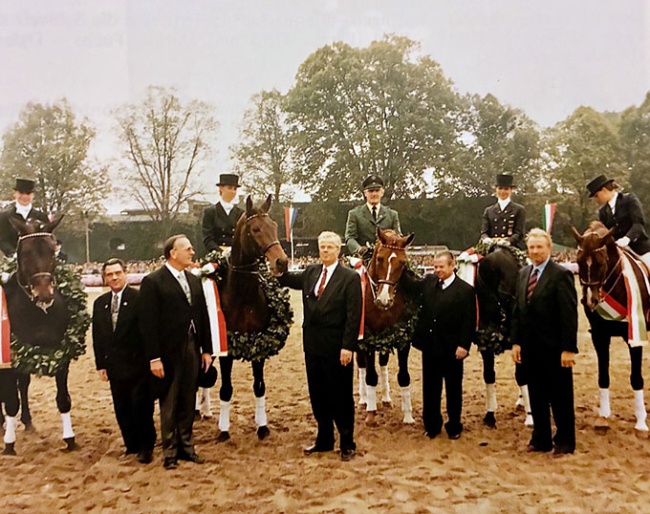
In the fall of 1982 the traditional and very popular annual stallion parades took place in Warendorf. That year they featured two prominent guests of honour: the 9-year-old dark chestnut Fire (by Frühlingsball II), ridden by Norbert Kopf, and the 11-year-old Ahlerich (by Angelo xx), ridden by Dr. Reiner Klimke. Both horses had recently been crowned world champions in show jumping and dressage, respectively, and epitomized the undeniable success of Dr. Lehmann’s breeding efforts in Westphalia.
Over the next ten plus years, Dr. Lehmann would welcome many more Westphalian-bred world champions and Olympic gold medalists to the arena at the State Stud during the stallion parades. No one could fail to notice that, in less than two decades under Lehmann's visionary leadership and with the active support of Dr. Dohmen, Westphalia had become one of the world’s leading breeding regions.
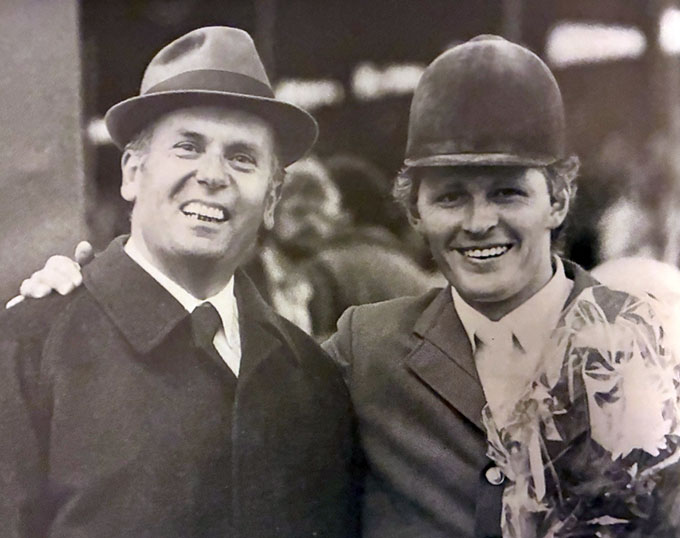
jumping World champion in 1978 on Roman
The first Westphalian world champion in show jumping was the bay gelding Roman (by Romadour I) under Gerd Wildfang in 1978. Ahlerich, undoubtedly Reiner Klimke’s horse of a lifetime, came to the “dressage rider of the century” through the 1975 Westphalian Auction. Dr. Dohmen had had the clever marketing idea of finally pairing the Westphalian Klimke with a Westphalian horse, after Klimke had previously ridden two Hanoverians — Dux and Mehmed — to Olympic gold.
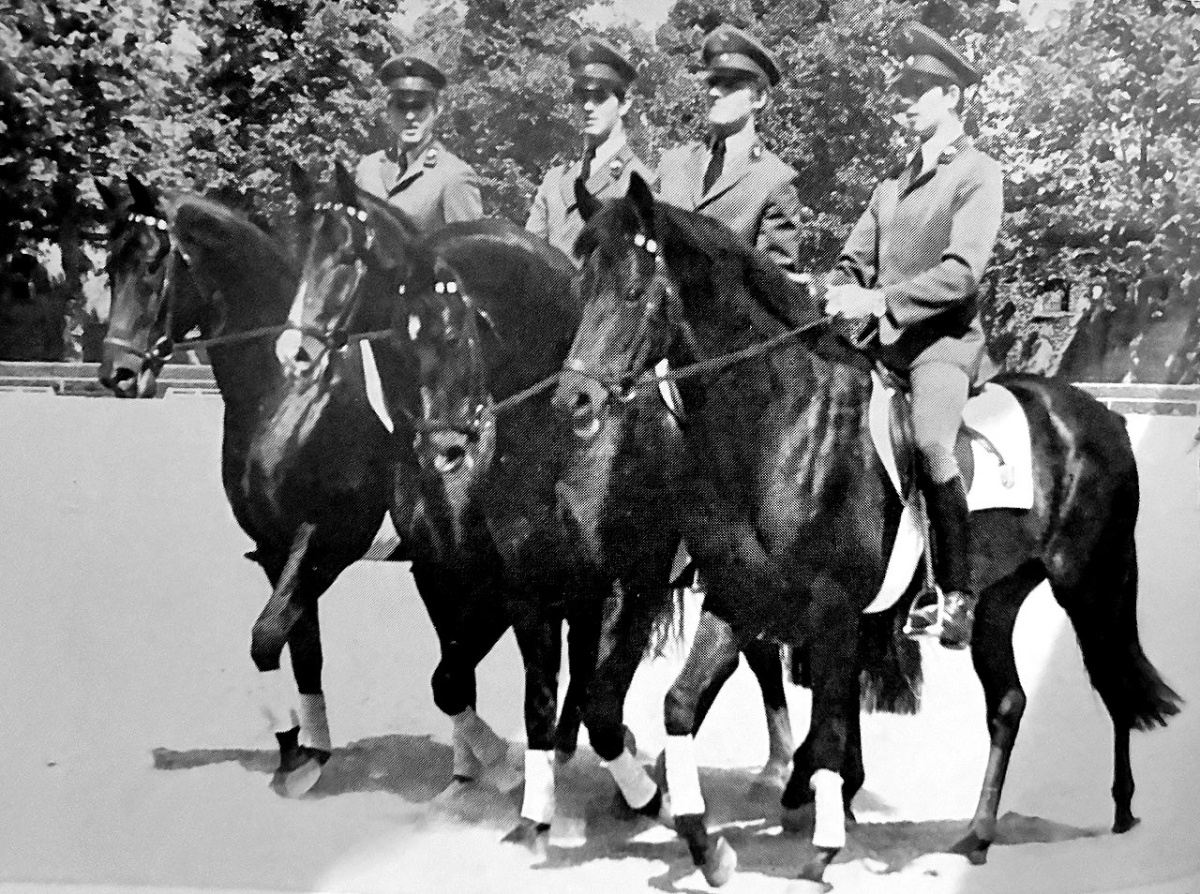
in 1976 with Romadour II (2nd left) and Windesi xx (far right).
A Decisive Retirement
Coinciding with Lehmann’s 25th anniversary of service, Westphalia ranked first in the breeding rankings, ahead of France and The Netherlands.
After a quarter-century at the helm of the Westphalian State Stud, the time had come for honours. For his contributions to horse breeding as the head of a state institution such as the State Stud, Dr. Lehmann was awarded the highest honour of the Federal Republic of Germany: the Federal Cross of Merit. That same year, during the “Turnier der Sieger” in Münster, the Westphalian Riding Association awarded him the Ramzes Prize for his outstanding contributions to Westphalian breeding. In 1995, the highest honour from the German Equestrian Federation followed: the German Equestrian Cross in Gold.
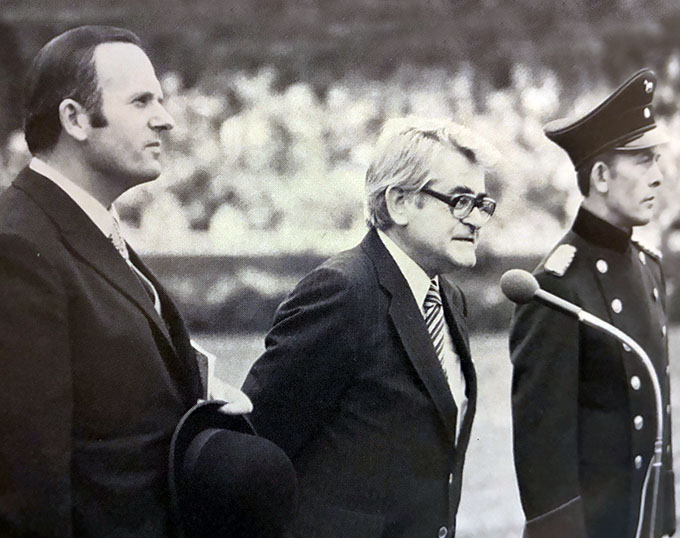
in his speech on his occasion of the state stud’s 150th
anniversary in 1976. Lehmann on the left.
They sent a management consulting firm to the stud farm which had to make its decision based solely on cost considerations. The goal was to reduce costs and increase the state stud farm’s profitability, which ultimately meant cutting staff, stallions, and breeding stations. In return, artificial insemination, which had been introduced at the stud farm in 1980, was to be expanded. For Lehmann, a man devoted to horses and deeply aware of the tradition, the ideals and breeding value of the Westphalian State Stud, this must have felt like a very painful slap in the face.
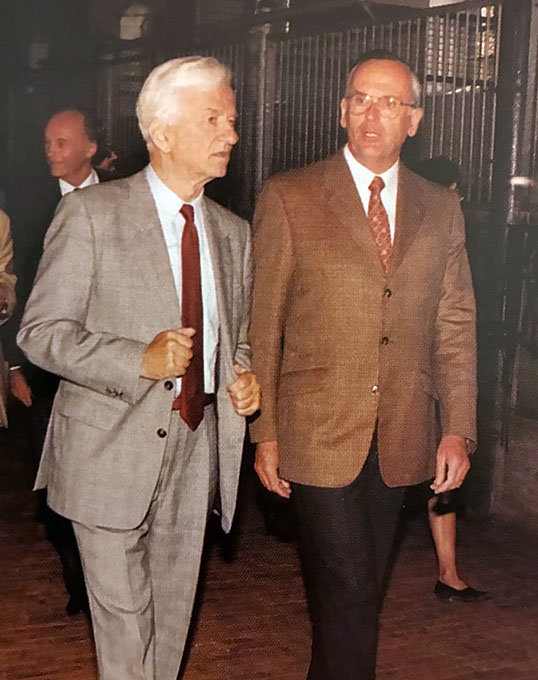
president of Germany and Dr. Lehmann
In our extremely fast-paced world, hard-won achievements in all areas of life are taken for granted, and the tremendous contributions of those who made them possible are thus forgotten. The fact that the Westphalian State Stud and with it, Westphalian breeding is so well-established and successful today is in no small part due to the work of Dr. Gerd Lehmann.
This, in particular, is something we should remember with a certain humility, especially on the occasion of a jubilee such as the one the Westphalian State Stud is celebrating this year. As the late German riding master Günther Festerling once said, “those who do not know the past cannot understand the present.”
-- Text © Silke Rottermann for Eurodressage
Reference List
- Conversations with Dr. Gerd Lehmann in August 2026
- Hermann Kothe, Vollblut in den Landeszuchten - Ist Härte nicht mehr gefragt?, in: Sankt Georg 10/82, Seiten 50 - 57.
- Knoll, Lore, Preuße alter Schule, in: Sankt Georg, 12/83, Seiten 66-69.
- Hans-Joachim Köhler, Vom Wirtschaftspferd zum Leistungssportler, in: Sankt Georg 12/84, Seiten 36 - 40.
- Franz-Josef Neuhaus, Zuchtschätze, Bedeutende Stutenfamilien in Westfalen, Münster ohne Jahr, Seiten 186 - 205.
- Jasper Nissen, Geht der Zucht der Saft aus?, in: Sankt Georg 4/2000, Seiten 13-17.
- Reiter und Pferde in Westfalen (Hg.), Pferdezucht im Wandel - Festschrift für Gerd Lehmann, 25 Jahre Landstallmeister in Warendorf, Münster-Hiltrup 1991.
- Rolf Schettler, Hengstauswahl - Zuchtfortschritt mit bewährten Alten oder modernen Jungen?, in: Sankt Georg 11/85, Seiten 52 - 53.
- M. Stoffregen-Böller / F.-J. Neuhaus / O.Marré / H. Heuoel, Westfalen-Die Jahrhundertpferde, Münster 2004.
Related Links
Dr Gerd Lehmann: A Groundbreaker for Modern Westfalian Breeding - Part I
Dr Gerd Lehmann: A Groundbreaker for Modern Westfalian Breeding - Part II