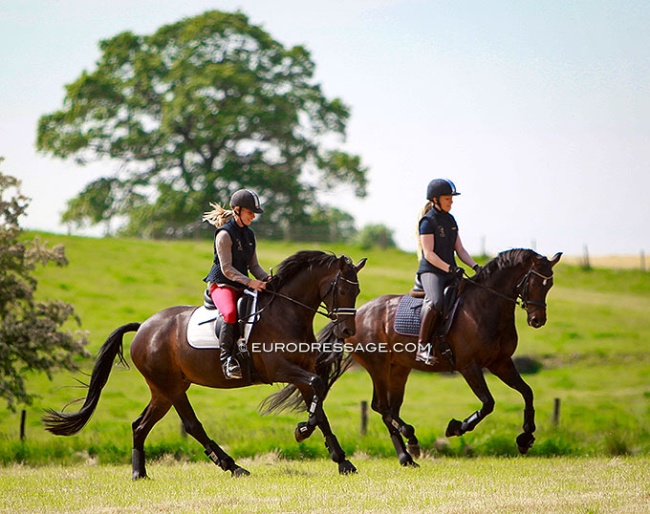
-- by Sarah Warne-Furtado
According to equine specialist in veterinary surgery and sports medicine Dr. Tracy Turner (DVM, Dipl. ACVS, Dipl. ACVSMR), one of the most overlooked aspects of horse welfare management is proper conditioning for a horse’s intended use.
“The horse needs the endurance, stamina, heart conditioning, and strength to do what it needs to do to, for the time it needs to do it,” says Turner. “Beyond that, he needs to be in good enough shape to recover quickly.”
Lack of Conditioning
I asked Tracy then if riders just ride for twenty minutes on the same rein and expect their horse to be fit for competition, and he laughed but replied, “Well, yeah! You see that all the time,” Turner says that while this exists across the equestrian community, dressage is usually where you see it the most.
“The horses that are typically fitter are upper-level event horses. Next are the show jumpers, who are far more fit than the dressage horses. At least in America, the dressage horses I see are very unfit.”
Turner advises that this lack of conditioning then leads to repeated injuries and time off, with owners seeking treatment after treatment but without looking at the cause.
“These horses don’t get enough time to be horses. They are in the stall, then they are in the arena, then they go back to the stall.”
Why Aren’t Dressage Riders Properly Conditioning Their Horses?
“I think it’s fear,” says Turner. “Here in the US, there is a huge amount of dressage riders who are afraid of their horses. They have some the best-trained horses in the world, but they won’t do roads and tracks. They won’t ride them out of the arena.”

“Absolutely,” says Turner. “This is true of every equestrian sport, at every level! I even see it in Western sport.”
In reining, for example, Turner says that trainers want the ability to sedate the horse with a small amount of sedation.
“Is that for the horse, or for the rider who can’t ride it?” responds Tracy. “And if they can’t ride it, why are the horses being bred like that?”
Good horsemanship requires honestly assessing whether a horse has the temperament and training that is compatible with the rider's education, ability and capacity. Turner believes that horses need variability, and if riders cannot provide that, then they should be asking if the horse is right for them.
Variability of Training
“Horses do better when they can be free (to a point),” says Turner. “Roads and tracks are great for their fitness, for muscle conditioning, and especially good for the horse’s mind.”
So what are the components of a good, varied programme, to properly condition a dressage horse?

2015 European Championships
Some riders include lunging as varied work, but Tracy warns that there is lunging and there is lunging.
“Lunging is an art in itself. It’s not chasing the horse around. This can cause more harm than good. You must learn how to lunge well and implement it correctly, but even then, it doesn’t replace trail work.”
As many riders live in urban areas, Turner suggests that if you don’t have space for trail riding, put the horse in the float and find a place where you can go.
“Loading the horse into the trailer frequently markedly reduces stress when loading,” she explains “Horses are creatures of habit. Once they get used to something, it’s nothing for them.”
Proper Conditioning and Horse Welfare
Dressage horses are often highly valuable and riders think they are protecting the horses by riding them in contained environments, but Turner says the opposite is true.

at the 2022 European JR/YR Championships
Turner advises that it is never too late to start, but that varied conditioning really needs to be developed from the beginning.
“Varied and correct conditioning needs to be incorporated from the start as part of an ongoing training process,” she explains, stressing that proper conditioning for intended purpose must be considered an important part of horse management.
“Not taking the horse out, not varying his training, is really going against the welfare of the horse," she adds. “The horse needs the endurance, stamina, cardiovascular conditioning, and strength to do what is being asked of him for the required period of time. Just as importantly, he needs the ability to recover quickly afterwards.”
More Training Articles on Eurodressage
Photos © Astrid Appels - Barbara Schnell - Silke Rottermann