- Text by Sarah Warne-Furtado for Eurodressage
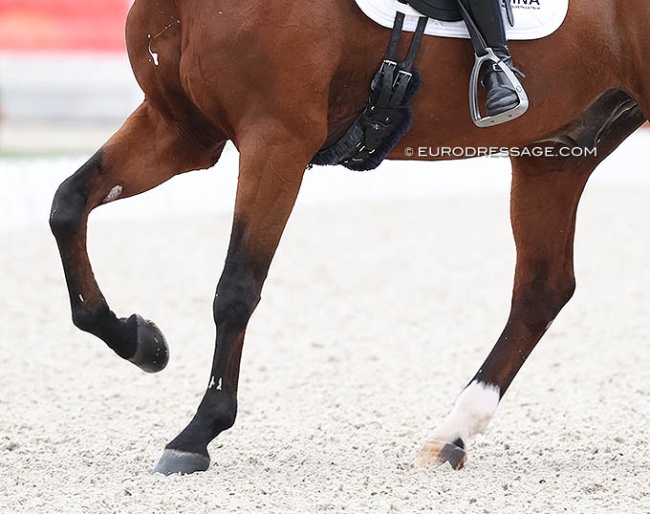
Following on from “The Aid to Initiate Canter,” where the feedback was to take the outside leg slightly back, international dressage rider and trainer Kyra Kyrklund instead uses the inside leg as her main aid to initiate canter.
Canter with the Inside Leg
“I go into the canter with the inside leg because then I can check the horse before the departure into canter,” says Kyra. “I first want to see that the horse reacts to my inside leg. For that I see if he will yield when I apply my lower inside leg. In this way I can see if the horse is prepared to make the transition."
Kyra finds this particularly helpful when you have a hot, or more sensitive horse.
“If you have a very hot horse you can’t just suddenly come with the leg as they will make a leap into the canter,” says Kyra. “Asking for canter on the more sensitive horse in this way helps, as you have the inside leg there already, so you can just slide it forward a little to ask for the canter.”
Shifting the Weight
Not putting the outside leg back at all to ask for canter, Kyra does shift the weight onto the inside seat bone, while putting the inside leg slightly forward and on.
“I usually do a slight yielding (move to the side away from the leg) from the inside leg before asking the transition. I don’t always need to, but I need to get the feeling that I could, that the horse is ready and listening to my inside leg. In checking this I can activate the diagonal aids. If my left leg is my inside leg, by having the horse prepared to yield off this leg, the horse is going straight into my right rein (outside rein).”
This, according to Kyra, allows the rider to relax the contact a little on the inside rein as they go into the canter, so the horse has space to come up with the inside shoulder.
Lazy Horses
“If you have a lazy horse and you try to yield him off the inside leg (ask him to move away from the leg), and nothing happens, then you know you will need to give a bit stronger aid,” says Kyra. “As mentioned in part one, the horse goes into canter when the outside hind is on the ground, but it is very difficult to know exactly the right moment. This is why I wait one or two steps. So If I apply the aid and the horse doesn’t go immediately into canter then I wait for the next step, so the horse is in balance. If you demand going into canter in the exact moment you give the aid and the horse is not on the right step to make the transition, he either goes into the wrong canter lead, or may not step through correctly with the hind leg."
While Kyra learnt in the riding school to take the outside leg back, she feels that using this aid makes it easy for the horse to fall out through the outside shoulder and to come in with the hind legs (quarters in).
“I have asked for canter with the inside leg for as long as I have been riding Grand Prix, so I must have done it for 40 years,” says Kyra. “It was something that I found out. I had both slow and quick/sensitive horses, so it was a way for me to be able to adjust and test the sensitivity, maintain the straightness, and also it allowed me to give the inside rein into the transition.”
If you hold onto the inside rein, or flex the horse too much to the inside in the canter transition, or keep too strong a contact, Kyra warns that this makes it very difficult for the horse to lift up in front.
Flying Changes
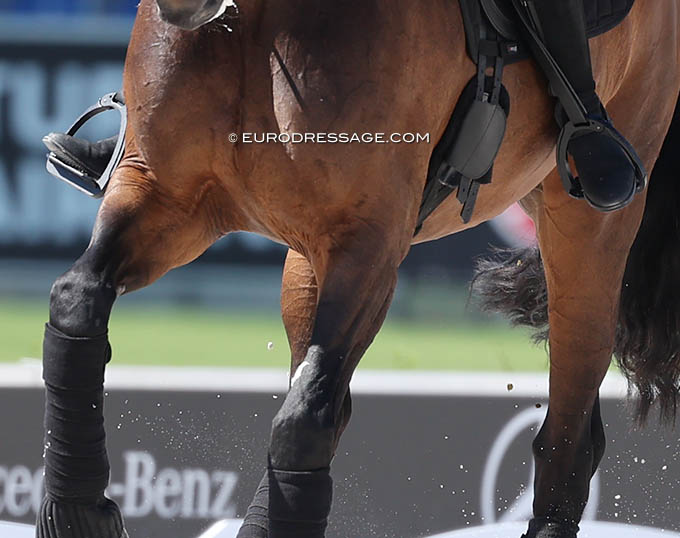
As for the flying changes? “The inside leg is always the main aid for the horse to change,” says Kyra.
Kyra describes that she had tremendous problems with the flying changes early on in her riding career because she was doing changes like a show jumping rider with the rein.
The turning point for Kyra was when she trained with Herbert Rehbein, who she says was very good at training flying changes.
“To make the change starting in left canter, I activate the horse with my right leg, to check he has energy. I don’t want to use too much inside leg during the canter as that is the main aid to ask the change, so if I can stay very light with the inside leg I only need a small aid for the change. In the canter if I want more energy or to go more forward, I ask it with more outside leg than inside leg,” advises Kyra. “To ask the change I ask over three strides. On the first stride I check to see if he is listening to me, that gives me the information if the change is going to be easy. On the second stride I take my inside leg a little bit back, and on the third stride I use the inside leg aid and the horse should do the change.”
Kyra adds that during this you must also have an aid to tell the horse not to run away and not to accelerate as you ask the change, and she does this with the old inside rein.
“When you come to the one time changes you have very little time, so you need to keep the aid as small and as light as possible. ( i.e outside leg not back too far so that you end up swinging the legs from side to side.)"
Retraining the Aid
I wondered then if someone has taught the horse to canter with an outside leg aid, in what circumstance would you retrain the aid?
“Depends on how they go into canter. If the transition is good then I don’t need to change anything. In principle you can teach the horse to go to left canter by pulling on the left ear,” jokes Kyra.
“The transitions from passage to canter for example is a very difficult transition, and many times if you are by the track the horse pushes the shoulder towards the outside of the track. If he is on two tracks before the canter, you can stay a little bit inside the track and then push the hind leg more to the track (with the inside leg), then when I hit the track I ask the canter so that the horse is not falling to the inside.”
Most of Kyra’s students use inside leg to initiate canter because Kyra feels it sets them up for the future.
“When they ride the Grand Prix then that canter transition from passage is, as I said, difficult. Somewhere in training you have to be able to influence the horse before going into canter. If it’s straight and it’s good then I don’t need to change anything. However, if it’s not straight or the horse is not on the aid, or he jumps going into the canter, then you have to change something, and I would change it like this,” adds Kyra.
As to when to introduce inside leg aid to canter, Kyra states that the sooner you introduce it the easier it will be.
“I would say that in training riders, even if they don’t ride Grand Prix yet, it’s good to have a system that is set up for Grand Prix. This way you don’t need to change something later on.”
Photos © Astrid Appels
Related Link
Classical Training: The Aid to Initiate Canter