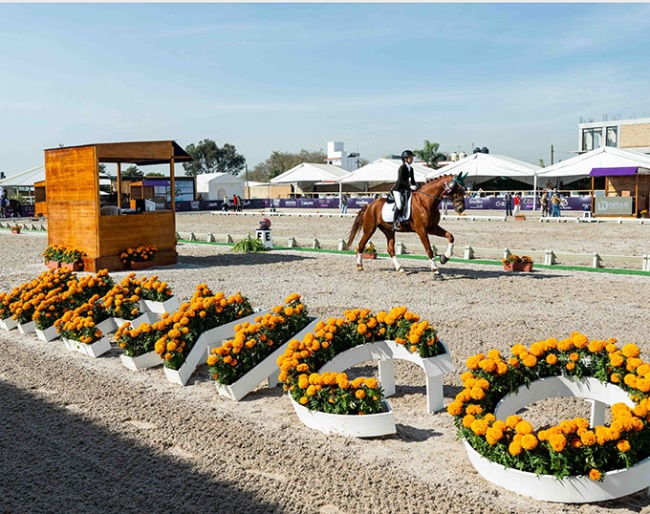
In recent years dressage in Mexico has entered a phase of steady and deliberate development, marked by increased international participation, investment in education, and a clear effort to raise the technical standard of the sport.
One of the clearest indicators of this progress is the growing presence of Mexican riders on the international stage. Mexico has recently qualified combinations for key benchmarks such as the FEI World Breeding Championships in Ermelo, and the upcoming World Equestrian Games in Aachen 2026. Carolina Cordoba and Santiago Ortiz Díez are hose already qualified for Aachen, while additional riders still have opportunities through upcoming CDIs.
Raising Standards Through International Exposure
A key part of this progress has been aligning national competition with international expectations.
Five-star judges are now regularly invited not only to CDIs but also to national shows. Mexican CDIs typically include at least two five-star international judges, and the recent National Championships have consistently featured strong international panels with multiple top-level officials.
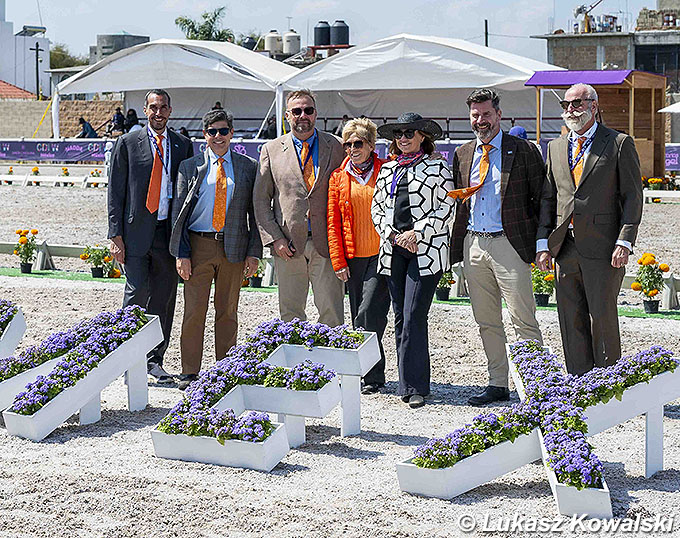
The Mexican Equestrian Federation has also increasingly taken into account riders training and competing abroad, recognizing their role in raising the overall standard and integrating their experience into the national structure.
"We believe real progress that has been made in Mexico in terms of the quality and standard of our competitions," said Mexican dressage committee member Valeria Castillo. "This development is now creating real opportunities for riders to achieve qualification results without necessarily having to base themselves in Europe or do extended tours abroad."
Investment in Education
Significant emphasis has also been placed on education.
A structured program for national judges has included seminars with leading international figures such as Katrina Wüst, Hans-Christian Matthiesen, Clive Halsall, Isobel Wessels, Christophe Umbach, Eike Elbert, Irina Maknami, and Henning Lehmann, among others.
"A broader trainer development program is also being developed, although distance and logistics with Europe remain a challenge," Valeria explained;
Results Starting to Show
These efforts are beginning to translate into results.
There has been a clear increase in the number of Grand Prix horses competing in Mexico, including several produced by Mexican riders. This reflects a strengthening structure within the sport and a growing ability to develop horses to the highest level domestically.
"We fully recognize and support those riders who have successfully qualified while competing in Europe. This is an important and valuable pathway, and their achievements should absolutely be acknowledged, but at the same time we are thrilled to see the growth of our national shows," Castillo explained. "They offer an alternative route and that this represents a meaningful step forward for the sport in Mexico."
Youth and Future Outlook
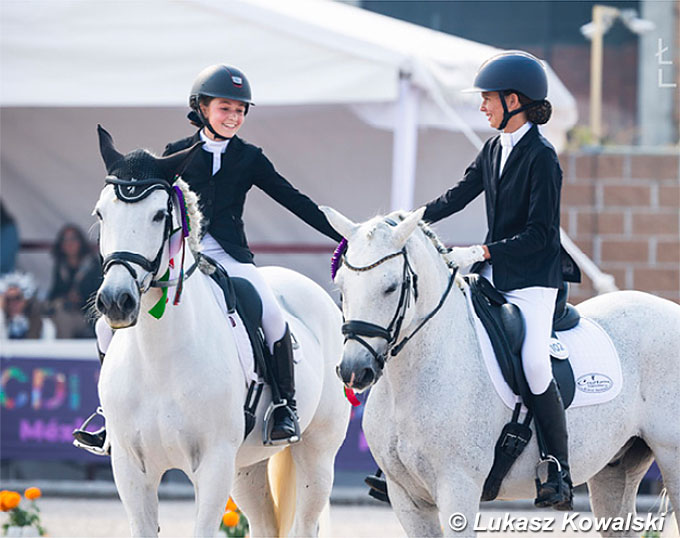
While challenges remain, particularly due to geography making travelling difficult, the direction is clear: a long-term, structured approach focused on raising standards, creating opportunities, and building a stronger presence in international dressage.
"For a country like Mexico, these steps represent not only progress, but the foundation for long-term international competitiveness," Castillo concluded.
Photos © Lukasz Kowalski
Related Links
Two Mexican Riders Qualified for the 2026 World Championships in Aachen
CDI-W Mexico 2025: A Celebration of Passion, Excellence, and Unity
Nadine Capellmann's Waitoni Sold to Mexico, Hocus Pocus Moved to Holland
Simonson's U25 Mount Son of a Lady Sold to Mexico
Urquiza, Escobar, Trapala, Valverde, Ortiz Win FEI Titles at 2024 Mexican Dressage Championships
Success of the First CDI-W in Mexico: A Celebration of Equestrian Brotherhood, Tradition, and Elite Sport
Milestone for Mexico with North American League World Cup Premier at 2024 CDI-W Lerma
Mexico To Send First Ever Team to 2023 North American Junior Riders Championships